
What is a bookworm? The Cambridge dictionary definition describes it as “Someone who reads a lot.” For Lucy Mangan it means so much more than that. In the introduction to this homage to the joys of reading she says that books are so important to her that “they made me who I am.” This, I think, applies particularly to the books that we read in childhood. In her best selling memoir Lucy Mangan reflects on the characters and worlds that books brought to life for her when she was young and in doing so confirms something that I have long believed. Reading is not something done in isolation, it connects us. To the characters, to the author and to the book’s other readers. It is a shared experience that unites us in an understanding.

Lucy Mangan’s memory for detail is impressive as she takes us on her reading journey from her early encounter with The Very Hungry Caterpillar all the way on through her school days culminating in her teenage reading of Summer With a German Soldier. Along the way we detour to savour the best of children’s illustration, an obsession with Enid Blyton and the Sweet Valley High series and a healthy dose of classics such as Tom’s Midnight Garden and What Katy Did. The range of titles enjoyed is broad and even those that Mangan enjoyed less or even not at all are ascribed an importance in so far as she recognises that they are important to other readers. In addition to the delightful and sometimes hilarious anecdotes about her childhood, her reading choices and her family Lucy Mangan also includes a brief history or further background information about the authors and illustrators she loved or the literary trends that helped to produce their books. I found this aspect fascinating and it has prompted me to want to find out more about some that were mentioned.
As is often the case with a budding bookworm there is an adult behind the scenes acting as a guide or mentor. For Lucy Mangan this was her father whose sharing of beloved books at the right time is wonderful, a gentle suggestion or a book given with a quiet encouragement that was so appreciated by his daughter. This is an approach that can be equally successful in libraries and schools, subtly nudging a would be reader and opening the door a little onto a whole new world. On many pages I smiled in recognition of a beloved book or a particular character and often my favourites were those of Mangan’s. This is interesting in itself as I am older and my formative reading experience took place in the 1960s rather than the 70s or early 80s. We shared a love of the classic Ladybird information books, Enid Blyton’s Willow Farm and numerous pony books despite the fact, or maybe even because of it, that we would never ever have ponies of our own. However, perhaps this age difference would account for the marked difference in our teenage reading habits. In the early to mid 1970s a teen or YA market did not exist as such and like my contemporaries I jumped from a childhood world of magic, schools, animals and adventure to that of adult best sellers with a short diversion to the classics in between. I fear I may have missed out a little.
One aspect that remains the same for all bookworms regardless of the decade is that when we read we are transported to another place entirely. Oblivious to distractions, summons to ‘come and eat’, ‘do homework’ or all the other pleas from our parents that fell on deaf ears as we fought battles in Narnia or accompanied Jill as she won yet another rosette in a gymkhana.
Another aspect that Lucy Mangan mentioned and one I have noticed in my work as a school librarian is that for child readers rereading is a vital part of the process. For adults the desire to try something new, the fear of missing out on wonderful new books or of wasting precious time is a nagging and real concern. For children it is different. Firstly there is the mechanics of reading itself, the just learned skill of decoding and discovering the meaning of words takes effort, then the understanding of the plot itself requires concentration and often a second look. Only once all this is done can a child return, reread and ponder on the characters themselves, their development, the underlying emotion or relevance to themselves and to their own lives. Hence the need and the desire to reread old favourites. We need to remind ourselves of this instead of rushing young readers on to the next level or pushing them too fast too soon.
This book is full of warmth, great humour and an honest insight into the slightly obsessive love that many of us have for the books that we care about. I enjoyed it thoroughly and found it nostalgic in the best possible way. Not a sad reflection of something long gone and now lost but a celebration of something that I am able to continue to build on and to share.
Bookworm – A Memoir of Childhood Reading is available at all good bookshops, your local library or online
This is my second book in the #20BooksOfSummer challenge organised by Cathy on 746 Books


 Cathy at 746 Books is hosting the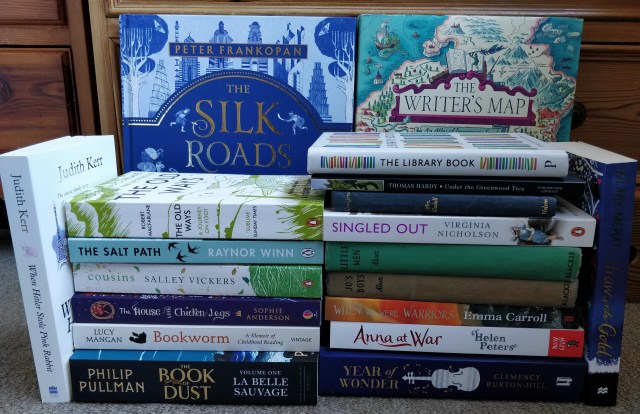


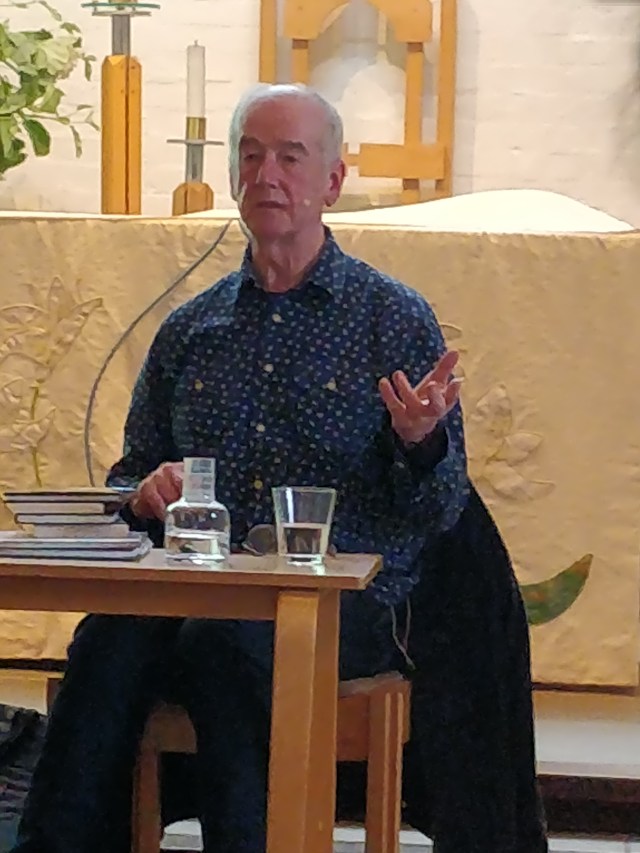 This hour of conversation passed far too quickly, I could have listened for ages. It was a wonderful, wide ranging discussion about writing, language and stories and full of inspiration for budding writers of all ages. David Almond’s books frequently use the language of his native north east and during his conversation he touched on the importance of this and of really engaging with the rhythm and sound of words when we read or write as this can be so beautiful.
As a child he grew up surrounded by aural story telling and loved myths and legends, enjoying books by authors such as Roger Lancelyn Green. He also occasionally pinched his sister’s Enid Blyton books! Libraries, as is so often the case, were important to the author and his reading material expanded to include John Wyndham and Ernest Hemmingway.
Bex asked David Almond about his books and about the specifics of the writing process. His answers were extremely thought provoking. He mentioned that writers have to be quite brave and said that any good book is created by something inside the writer, “writing is a physical, emotional thing that comes from your bones.”
There was, inevitably, a great deal of discussion about Skellig, a novel now used widely in schools. David said that he loves the stage play based on the book and is particularly happy to see how his book has touched readers and released something inside people. The wonderful thing about Skellig is to witness the creativity it has inspired in others. This is one of the reasons why books matter. All over the country teachers are working with children on art, drama and dance, all linked to this remarkable story.
When the children started asking questions David advised them that if they want to write they should read widely and when writing don’t write to try and impress anyone. He also gave them freedom to write the sequel to Skellig as he has no idea what happens next! The book itself leaves many unanswered questions. David also confessed that he finds starting a book easier than finishing it. He also warned the audience that all writers have doubts when writing and it’s important to learn to push aside the inner voice telling you that the story is no good.
This hour of conversation passed far too quickly, I could have listened for ages. It was a wonderful, wide ranging discussion about writing, language and stories and full of inspiration for budding writers of all ages. David Almond’s books frequently use the language of his native north east and during his conversation he touched on the importance of this and of really engaging with the rhythm and sound of words when we read or write as this can be so beautiful.
As a child he grew up surrounded by aural story telling and loved myths and legends, enjoying books by authors such as Roger Lancelyn Green. He also occasionally pinched his sister’s Enid Blyton books! Libraries, as is so often the case, were important to the author and his reading material expanded to include John Wyndham and Ernest Hemmingway.
Bex asked David Almond about his books and about the specifics of the writing process. His answers were extremely thought provoking. He mentioned that writers have to be quite brave and said that any good book is created by something inside the writer, “writing is a physical, emotional thing that comes from your bones.”
There was, inevitably, a great deal of discussion about Skellig, a novel now used widely in schools. David said that he loves the stage play based on the book and is particularly happy to see how his book has touched readers and released something inside people. The wonderful thing about Skellig is to witness the creativity it has inspired in others. This is one of the reasons why books matter. All over the country teachers are working with children on art, drama and dance, all linked to this remarkable story.
When the children started asking questions David advised them that if they want to write they should read widely and when writing don’t write to try and impress anyone. He also gave them freedom to write the sequel to Skellig as he has no idea what happens next! The book itself leaves many unanswered questions. David also confessed that he finds starting a book easier than finishing it. He also warned the audience that all writers have doubts when writing and it’s important to learn to push aside the inner voice telling you that the story is no good.


 Library Lady