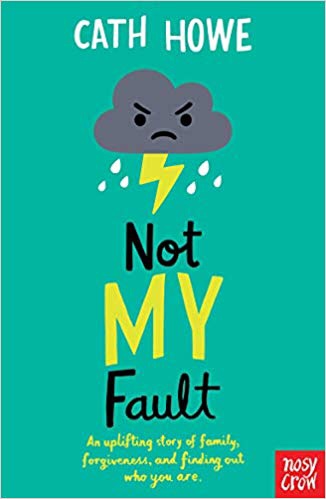
Not My Fault by Cath Howe

Ever since the accident Rose and her sister Maya have not been talking. Maya asked her sister to push her harder on the roundabout and when Rose did there were terrible results. Now Maya blames Rose and treats her unkindly and in her frustration behaves badly too. Rose, full of guilt for what has happened, wants to make things right again. The sisters have to go away on a week long residential school trip and their parents, teachers and even their friends worry about how this will work out. Will the trip mend the broken sibling bond or break it completely once and for all?

I am often intrigued by how two people can sometimes have entirely different recollections of exactly the same event. This often does not mean that they cannot remember the incident properly but simply that different aspects resonate more with people depending on their views, interests or attitudes. Cath Howe takes this a stage further by looking at how a traumatic event has a lasting effect on those who suffer it or witness it. In this case that the event involved children, and even more poignantly siblings, adds to the emotional impact.

Not My Fault is told in the alternating voices of the two sisters and this works extremely well. Maya and Rose are very different characters indeed and how much of this is due to the accident and how much is down to their individual personalities would be an interesting subject for discussion. Rose is reserved and quieter than her sister, she tries to be good and is a bit of a perfectionist whilst Maya is popular with other children at school, full of humour and with an air of bravado. Rose has become involved in the world of gymnastics and her increasing commitment and success results in Maya becoming even more bitter than before. Things come to a head during the school trip when events conspire to throw the sisters together despite their wish to stay apart.

Cath Howe is a primary school teacher and she has captured the voices of ten year olds and the highs and lows of residential school trips to perfection. The writing displays an understanding of children and is extremely well observed. This feels realistic and believable and I feel sure that young readers will find both the characters and the storyline relatable. School trips can be a source of worry for some children but this book demonstrates that despite these fears they should be, and generally are, an enjoyable and enriching experience. In addition to the main storyline about Maya and Rose, there are amusing moments and some of the supporting cast of characters including Maya’s friend, Bonnie and the poor harassed teacher, Mr Goodman are very appealing.

I enjoyed reading this and as I somehow never got around to reading this author’s acclaimed debut, Ella on the Outside, I will be putting that one on my to read list also.

Thank you very much to Rebecca Mason and Nosy Crow publishers for providing my free review copy.

If young readers enjoy this type of school story with relatable characters they may also enjoy Splash by Charli Howard


Posted in Book Review | Tagged , , , , , , , , | Leave a comment

Into the Bin (and out again) by Anne Fine illustrated by Vicky Gausden

Former Children’s Laureate and Carnegie Award winning author Anne Fine has written several shorter novels for Barrington Stoke over the years that have been extremely popular in the school library. Her latest offering Into the Bin (and out again) is a cheerful story that enables children to see that what one person may discard as rubbish may be something that another person would treasure. It is perfect for encouraging reusing and recycling.

Mr Frost’s classroom is always in a mess as is the cloakroom. The headteacher wants everywhere tidied up quickly. Now Mr Frost’s class are on a mission to send all the things they don’t need off to a charity shop. They are even including the scratched rubbish bin that keeps falling over. So the children bring things in from home that they no longer need, from books to old toys, they gather all sorts of things together to send away in the bin to the charity shop. However as they examine all the items they discover that what one person doesn’t want might be just the thing someone else has been looking for.

This timely story taps into the enthusiasm and interest shown by many eco-conscious children and would be a valuable prompt for discussion in the classroom. However it is also a jolly read and the various reasons why discarded things may be valued by others are interesting and thought provoking.

This book is part of the Barrington Stoke 4U2Read range and has a dyslexia-friendly layout, typeface and paperstock so that even more readers can enjoy it. It has been edited to a reading age of 7.

The first chapter is available to read on the Barrington Stoke website.

I am delighted to welcome Anne Fine to my blog today to talk about Into the Bin, the role of the Children’s Laureate and children’s books.


LL. The subject matter of Into the Bin is excellent for encouraging the current interest shown by children in protecting our planet. Was there a specific event or situation which inspired you to write the book?

AF. I take as much interest as anyone else in the safety of the planet, and am very aware that those of school age, including my own grandchildren, care about this matter a great deal. (Indeed, they nag adults about it in much the same way that my daughters nagged me about my smoking habit. And hopefully, like them, they’ll win.)

I suddenly remembered that each time their rooms had turned into garbage tips, I’d go in with large black bin bags and a firm purpose. Picking up every item in turn, I’d ask, “Trash, or treasure?” They’d snatch all treasures and heap them on the bed. Dried-up felt pens and banana skins went into the rubbish, and things they never wore or played with any more were dumped, after a lot of squawking, into the charity shop bag. The problem was that other members of the family gathered like gannets.  “You can’t throw that away. I want it.” “That’s perfect for my school project!” “I can use that!” So our family was well into recycling even before it became so popular, and I became very well aware that, for almost every object in the world, there is someone who can use it.

LL. Children’s fiction can be useful for making young people aware of situations and events they may know little about. Do you always consider that aspect when writing a book? 

AF. Not always. Sometimes an idea just comes to me, begging to be a book, and I’ll go with it. But Eva Ibbotson did once say that fiction ‘helped children lead big lives’. After all, you only get your own personal experience: your own country, your own social class, your own temperament, your own parents. Reading widens the child’s vicarious experience so much. But unlike many writers who expand their readers’ knowledge of other countries, times or  issues, like Beverly Naidoo or Elizabeth Laird, I tend to focus on trying to expand the thoughtfulness of their attitude towards those with other experiences, as in The Tulip Touch, or Blood Family. I stand with Susan Sontag, who said that she thought that the most useful thing that fiction could do was ‘increase the sense of the complexity of things’.

LL. This year marks the twentieth anniversary of the Children’s Laureate scheme. What is your happiest memory of your period as Laureate and what would be your dream for future Laureates to achieve in the next twenty years? 

AF. To be honest, my happiest memory was the day I finished. I was exhausted. The only back up for the Laureate at that time was Lois Beeson, a marvellous support but she lived in Southampton (I live in County Durham) and she fell seriously ill halfway through. So I ploughed on with the three main projects (www.myhomelibrary.org  ; http://www.clearvisionproject.org ; and the poetry anthologies A Shame to Miss 1, 2 & 3, plus a score of keynote addresses, and, looking back, a quite astonishing number of talks and visits.  My accountant actually queried whether I could possibly have caught as many trains as I claimed, and I never got to write a single word of fiction in the whole two years. But the two projects are still rolling along all these years later, and I am very, very proud of that.

I think one of the most interesting things about the Laureateship is how each person chooses to approach the role. But I expect we all share the same dream – to turn every child who could be a passionate reader into a passionate reader. I doubt if that will change over the next twenty years.

LL. You have been writing for children for many years. Do you think that their reading tastes have changed during that time?

AF. No, I don’t. I think publishers still second-guess what children will enjoy as much as they ever did, to the detriment of both the reading child and the industry. Of course, children’s lives have changed. The almost relentless ‘contact’ with others that comes from social media has to be taken into account if you’re writing about their lives now. But children themselves are no different, and their interest in, and emotional responses to, the sorts of problems that, sadly, never really change, won’t change either.

LL. You have published a wide range of books catering for different ages. Is there a particular age group you find most rewarding to write for or a genre you enjoy writing most?

AF. I keep trying to choose a favourite age group, but it won’t work. The idea comes, and I think, “Who’d like this idea most?” and then, till I’ve finished the book, that’s my favourite age group. (Though I admit that, after writing any of the eight adult novels, I felt like a piece of chewed string.) And I know that the prize winning children’s books, and the ones people want to talk to me about most, are the emotionally rich ones, like Goggle-Eyes or Step by Wicked Step. But I adored comedy as a child. So, secretly, my favourites are books like The More the Merrier, Eating Things on Sticks and Ivan the Terrible. I can almost hear my own daughters’ frequent expression. “We had a good laugh.” And I’d always be happy to settle for that.

I would like to thank Anne Fine for taking the time to answer my questions so fully. It has been a treat and I hope that readers have enjoyed the interesting responses as much as I have.

My thanks to Kirstin Lamb and Barrington Stoke for providing my free copy and for arranging the interview.


Posted in Author Q & A, Book Review | Tagged , , , , , , , , | Leave a comment

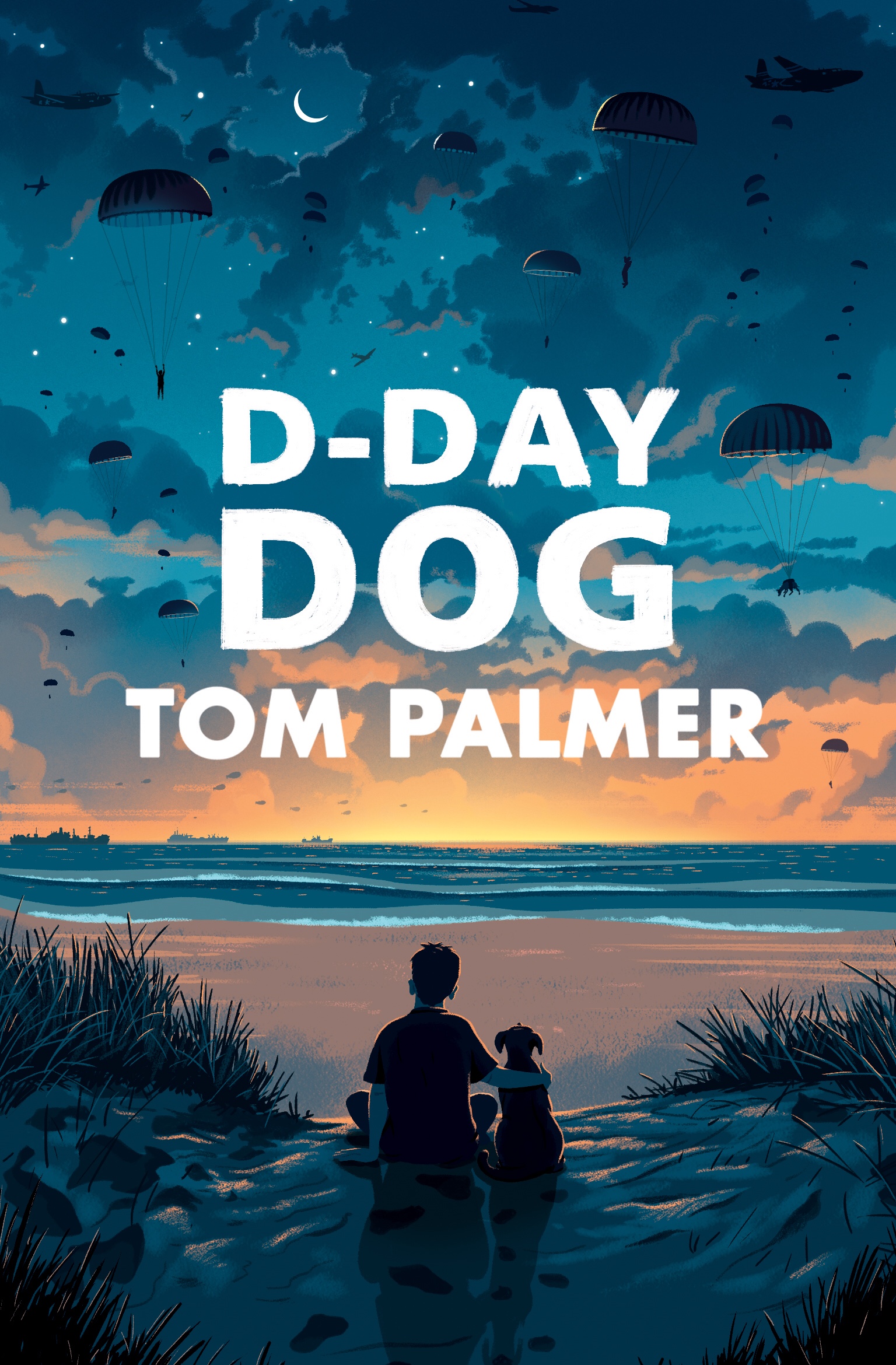
D-Day Dog by Tom Palmer

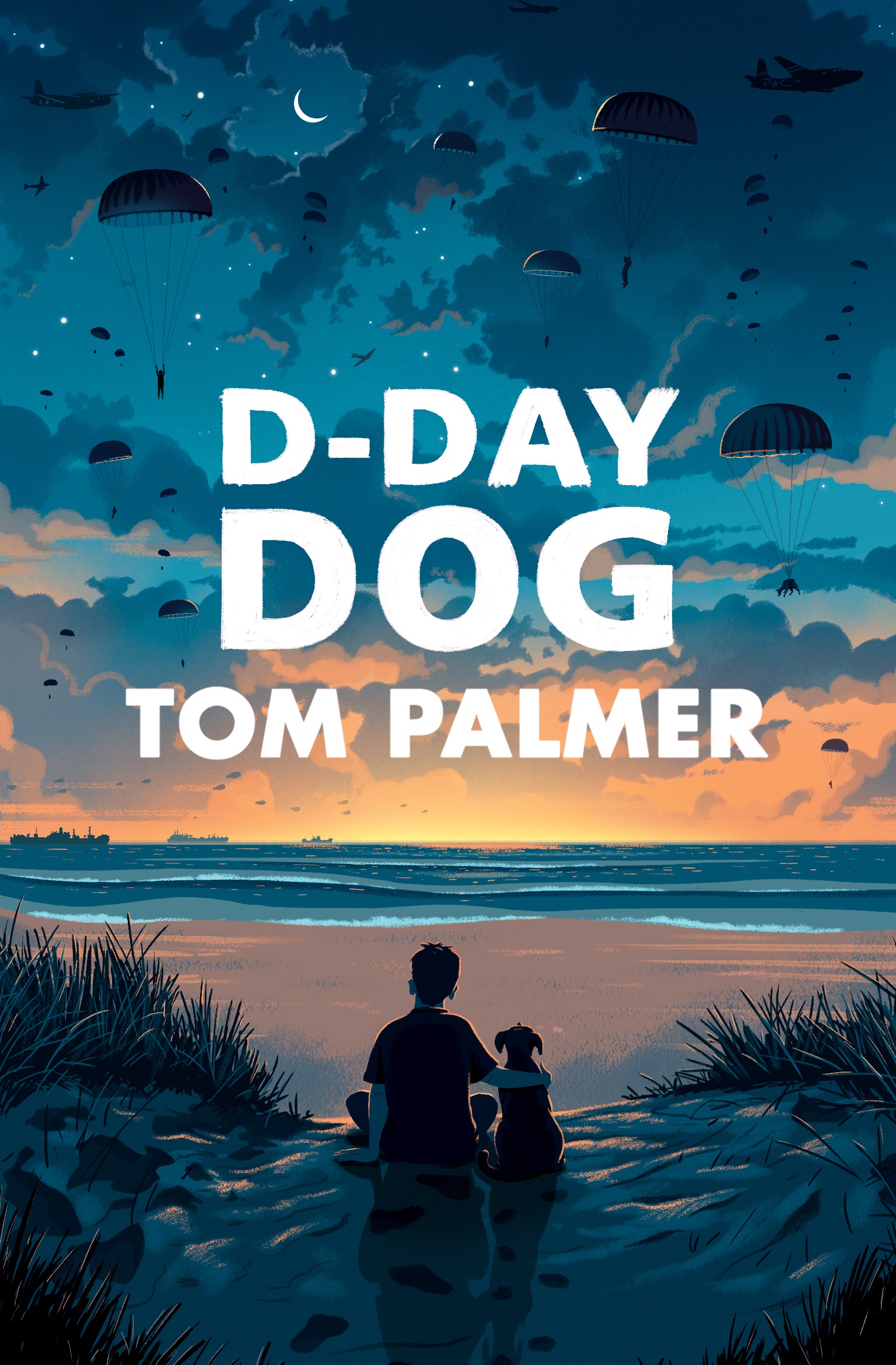
In this poignant and thought provoking World War 2 story Tom Palmer weaves together diverse voices to commemorate those who lost their lives during the D-Day Landings and sympathetically answers some of the most difficult questions about war itself. This is a must buy for school libraries.

Historical fiction gives a voice to those who are no longer with us and when it is written for children it enables them to see people from the past as flesh and blood human beings just the same as people today. This well researched and extremely thoughtfully written story will educate young readers as well as entertain them. Tom Palmer has linked together multiple strands and very different voices, bringing them together in a way that makes this difficult subject accessible to children.

Jack and his classmates in Year 6 are shortly to go on a residential trip to Normandy to visit the D-Day Landing beaches. Beforehand they have to learn more about the brave people who gave their lives so that others may have a future. This has particular relevance for Jack as his dad is a reserve soldier who is called up for action. This causes upset at home for Jack and prompts him to question all his previous attitudes to war. He seeks comfort with his beloved dog, Finn and at school starts to find out about a paratrooper who parachuted into France with his dog. As Jack carries out his research and the day of departure on their school trip draws near he learns more than he expected and during his time in Normandy Jack will find answers to his many questions.

In addition to the main storyline Tom Palmer includes a range of diverse characters including a young girl from Syria seeking asylum in the UK and a pupil who receives 1-1 support in the classroom. This never feels contrived but instead strikes a good balance and results in the story feeling true to life and relevant to today’s young readers. Jack himself is a character who children will empathise with, he tries to do the right thing but can make mistakes. His family situation and his relationships with his friends feel believable and as a reader I wanted things to work out well for him.

As with all Barrington Stoke’s books this book is also produced in a dyslexia friendly format and at 180 pages is not too daunting for the more reluctant reader.

This is a book that will make children think but does not preach at them, a tricky task to pull off effectively sometimes but Tom Palmer has achieved it. I would highly recommend this thoughtful book for school libraries and classrooms.

The eye catching cover is designed by Tom Clohosy Cole.

Thank you very much to Kirstin Lamb and Barrington Stoke for providing me with my free review copy.

Tom Palmer’s comprehensive website contains a range of free resources linked to this book which teachers are sure to find useful in the classroom. There are historical details and questions to prompt discussion at the end of the book too. Tom has also written about the inspiration for this important book on my blog here.


Posted in Book Review | Tagged , , , , , , , , , | 8 Comments

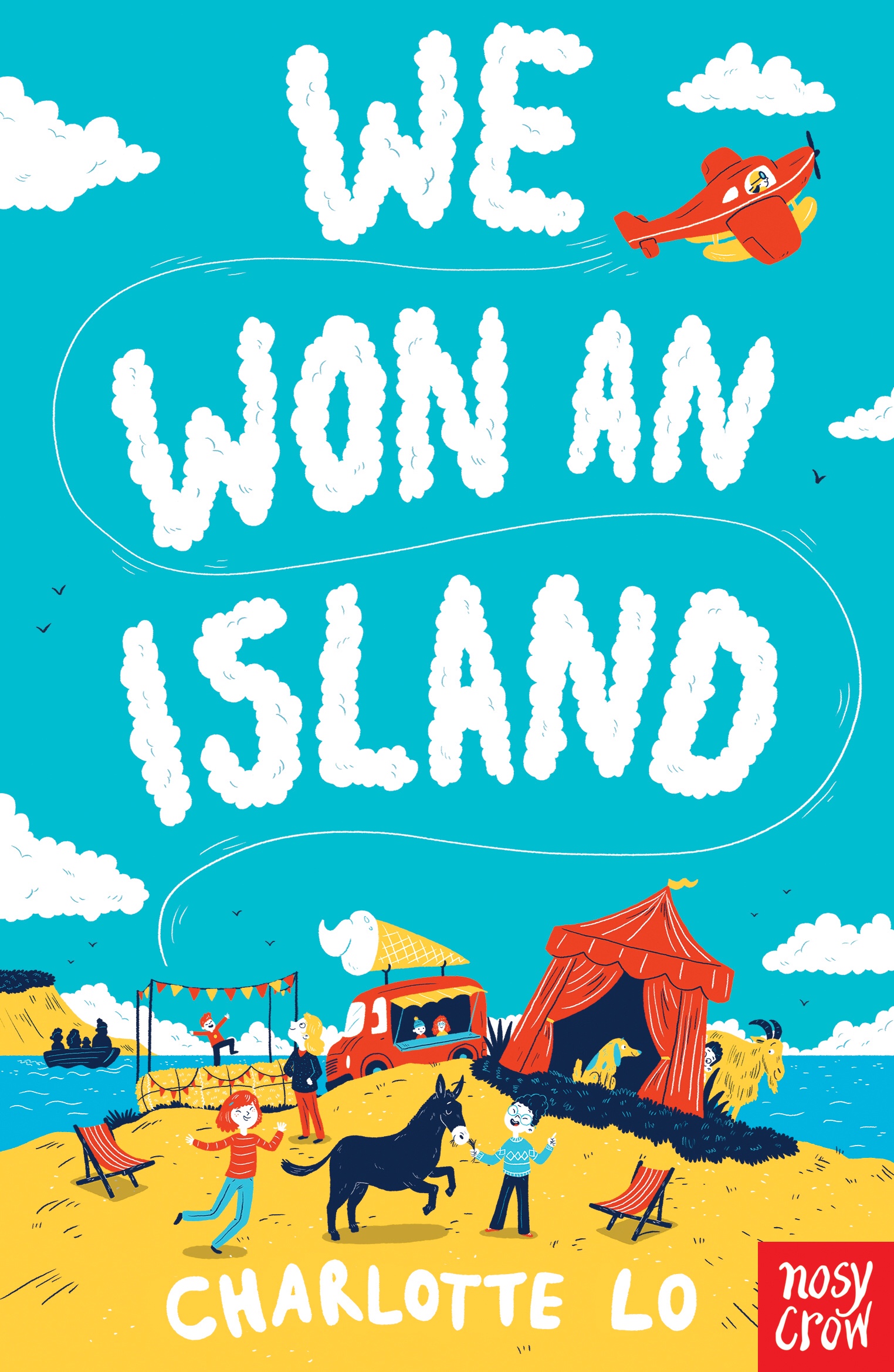
We Won an Island by Charlotte Lo

Islands have featured in fiction and in particular in children’s fiction for many years. From Kirrin Island in Enid Blyton’s Famous Five series to Stephenson’s Treasure Island, the islands in Kensuke’s Kingdom and Robinson Crusoe and also in picture books, like Struay in the Katie Morag series. Islands are often synonymous with adventure and sometimes with secrets too. The island in Charlotte Lo’s debut novel for children fits in perfectly with this theme. However there is a difference. In this story Luna and her family win an island in a competition. The island will be their new home.

When the family hear the news of their win Luna is absolutely delighted as she thinks she will finally be able to achieve her dream of acquiring a donkey of her own. Luna’s older sister, Margot is less thrilled. In fact initially she refuses to move. Fabien, the girls’ goat obsessed younger brother, is already planning how he will keep goats in their new home. Mum ponders the possibility of starting a yoga retreat on the island whilst Dad, still grief stricken after the death of the children’s much loved granny, is unable to raise enthusiasm for anything at the moment. However the move goes ahead and the family discover that their island is beautiful despite needing much work done on the house and its surroundings. Then their plans hit a few snags and things get rather tricky for the children with much hilarity and excitement along the way.

This is great fun and guaranteed to put smiles on faces. There is a very positive feel about the story which is engaging from the first pages onwards. The three very different children are fond of each other and the sibling relationships are realistic. The dramatic change to the family’s lifestyle is a good discussion trigger for children and some of the locals reactions to the new arrivals are interesting too. As the story progresses we watch Luna’s growing friendship with Kai, a boy from the mainland and the three children’s attempts to organise a festival both of which storylines encounter a few hiccups. Fabien is a delightful character and the cause of many of the books amusing moments. The reader is made aware of the grief suffered by families when a loved one dies but this is not dwelt on and in fact is dealt with in such a matter of fact way that younger readers will gain reassurance.

We Won an Island is a happy, enjoyable read which readers aged about 8 plus will enjoy, especially if they are animal lovers. It would work well read aloud too, the short chapters would be perfect for ten minute sessions in the classroom.

Thank you to Nosy Crow Books for providing me with my proof copy. The book has an attractive cover and chapter headings by Aviel Basi.


Posted in Book Review | Tagged , , , , , , , | Leave a comment

D-Day Dog by Tom Palmer – The inspiration for the story

One of my favourite children’s books from 2018 was the wonderful Armistice Runner by Tom Palmer. On 2nd May his latest book, D-Day Dog, is published in time to mark the commemoration of the 75th anniversary of the D-Day landings. It is another extremely thoughtful and powerful story. Tom has kindly written about his inspiration for D-Day Dog here. Thank you very much, Tom, for this interesting insight.

Putting Animals to War

How reading another animal at war story, The Snow Goose by Paul Gallico, inspired me to write D-Day Dog

 This was going to be a blog about why authors write about animals in war. There are a fair few children’s books that combine war and animals. Michael Morpurgo comes to mind, but there are others. Kate Cunningham. Megan Rix. Sam Angus. But I should let them speak for themselves and just say why I wanted to write about an animal’s role in war.

It was The Snow Goose by Paul Gallico for me. I didn’t read it until I was in my thirties, but when I did it got to me in a way none of the war films I’d watched or war comics I’d read as a kid got to me.

The Snow Goose is about a boat-owning solitary man, Rhayader, who lives out on the salt marshes of Essex. It’s set in 1940. With the help of a local girl he rescues and rehabilitates an injured goose. Then the call comes for small craft to save what is left of the stranded British Army. Rhayader has a boat. He works with the goose – who guides his boat – to help rescue stranded soldiers from Dunkirk.

For me it was the girl and her take on the man and the goose that drew me in. The emotional power!

I wasn’t a big children’s book reader until then. This changed my reading. And therefore, my writing.

So when I set about writing D-Day Dog I had that reading experience in mind.

My book is about a man, an animal and what happens to them on D-Day. As seen through the eyes of an eleven-year-old boy. I took Paul Gallico’s lead for this. For me Gallico’s story works because you see the adult-in-war and its relationship with an animal from a child’s point of view.

One of the big questions in D-Day Dog – for me – is whether it is acceptable to use animals in war. I was torn. I still am. If a pigeon can save a dozen soldiers’ lives – and survive itself – then why not? Ferrets are being used today to help rescue people from bombed buildings. But dogs with bombs strapped to them going under tanks? Never.

I wanted to explore my feelings and attitudes in D-Day Dog through a boy called Jack. Jack goes through the range of reactions I went through, thinking through his ideas about war.

I do my best not to sugar-coat animals’ involvement in war. The last scenes in D-Day Dog include Jack going to visit the grave of Glen, a Paradog, in France. And you hear – second hand – how Glen and his handler came to be buried there.

I’m still torn about whether animals should be used in war. But writing the book has helped me get my head round it.

Tom Palmer

Tom Palmer’s brilliant website includes interviews, chapter excerpts and a wonderful range of resources.


Posted in Book Review, Reading | Tagged , , , , , , , , | 1 Comment

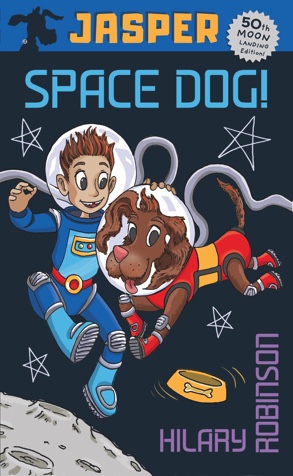
Jasper: Space Dog by Hilary Robinson illustrated by Lewis James

Published to coincide with the 50th anniversary of the first moon landing this entertaining book weaves fact and fiction together in a package that is designed to be accessible to a broad readership. Jasper would be a valuable addition to all primary school bookshelves.

The first in a new series by award winning author Hilary Robinson, this engaging book cleverly mixes facts with fiction in an entertaining way that results in children learning without them realising that they are doing so.

The story is told in the form of humorous letters between eight year old Charlie Tanner and Dr. Isabella Starr, a Rocket Scientist. Charlie asks questions about the moon and space travel on behalf of both himself and his extremely curious dog, Jasper. The questions young readers may want answers to themselves are put by this duo such as: Is the moon really made of cheese? How are space rockets powered? And, Why did one astronaut on Apollo 11 not walk on the moon? All these questions and more are answered with clear explanations and children will be learning while being entertained. Astrophysicist, Dr Suzie Imber acted as consultant for the book ensuring that all factual information is correct. In less than 100 pages it manages to cover a great deal and I even learned how Buzz Aldrin acquired his nickname!

A great deal of effort has been made to ensure that the book is designed with an inclusive approach and dyslexie font is used for the reduced text which is on cream paper and broken up by appealing illustrations. The artwork is provided by Lewis James, who is supported by The Prince’s Trust. Hilary Robinson also shared early drafts with teachers and children in several primary schools. All of this preparation has resulted in a package that should appeal to a broad range of young children, including both emergent and more confident readers.

This is the first in a new series, the second sees Jasper learning about the Vikings which sounds equally appealing.

I would like to thank Hilary and Strauss House Productions for sending me my proof copy.

Teaching Resources linked to Apollo Missions and the Moon Landings

If you are considering covering the anniversary of the moon landing and space travel in the classroom there are a range of online resources available. I have selected just a few that may be helpful.

Space Kids http://www.spacekids.co.uk/moon/ This site contains information about the Apollo missions including Apollo 11 and the first men who walked on the moon.

Peanuts and NASA http://ymiclassroom.com/lesson-plans/peanuts-nasa/ Fifty years ago Apollo 10, the NASA mission used Charlie Brown and Snoopy part of the U.S. space program when their names were used as call signs for the command and lunar landing modules. Now NASA and the Peanuts gang have teamed up to help students explore the history of space flight and the amazing technologies NASA will use to land astronauts on Mars. They have created separate activity sets and lesson plans for all primary school age groups which are available on this website.

ESA Space for Kids https://www.esa.int/kids/en/home The European Space Agency’s website for children. Information about spacecraft, the moon and more.

Posted in Book Review | Tagged , , , , , , , , , | 1 Comment

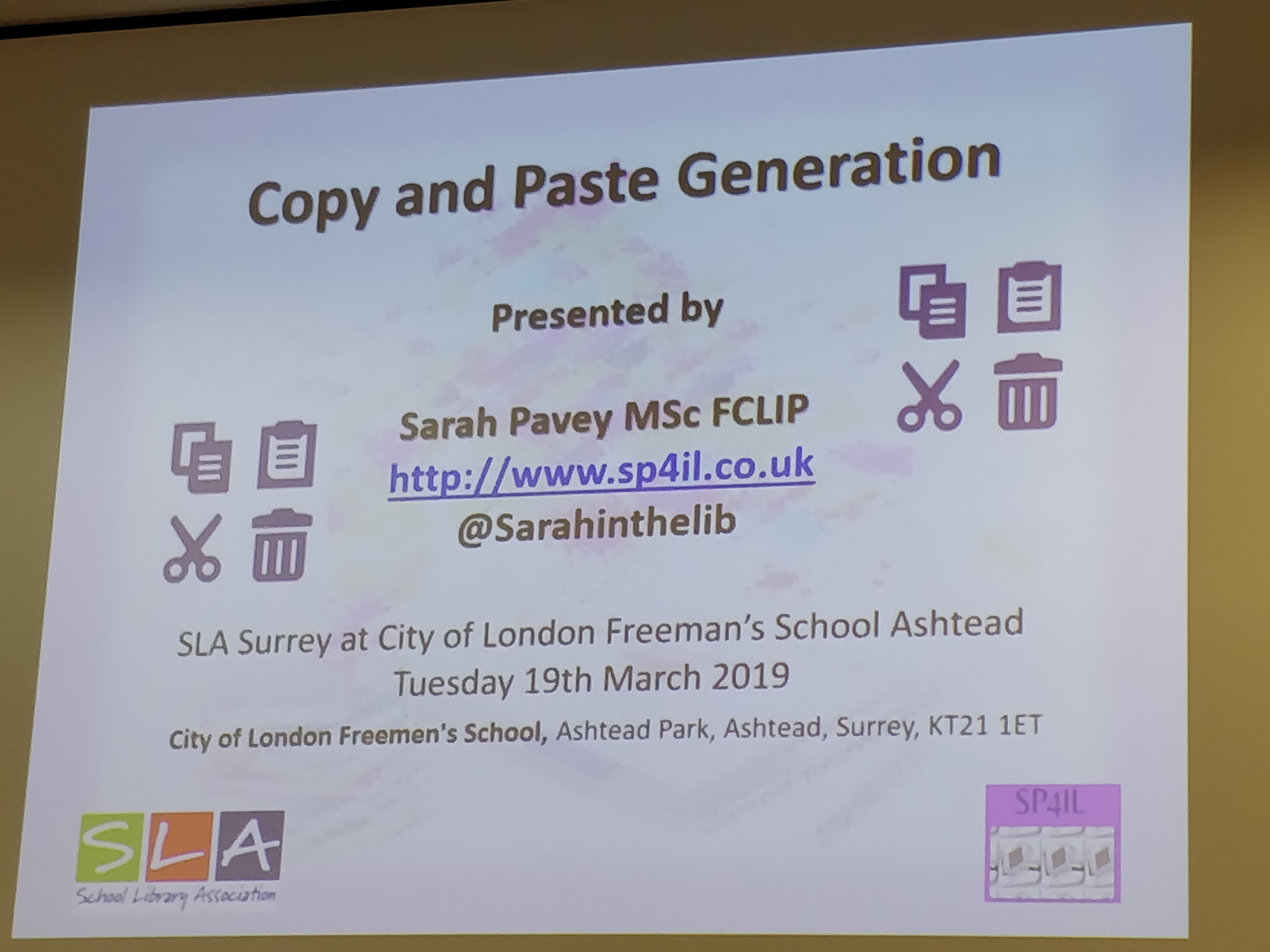
The Copy and Paste Generation and The School Librarian

Each term the Surrey branch of the School Library Association holds a meeting where members have the opportunity both to network and to gain some CPD in the form of visiting speakers offering training, advice or new ideas.

Our Spring term meeting took place this month at City of London Freemen’s School in Ashtead where we welcomed Sarah Pavey who was to speak on the subject of plagiarism, copyright and the role of the school librarian. Sarah is a former school librarian and now an independent trainer, consultant and author.

IMG_20190319_165042.jpg

This is obviously a wide ranging and important topic that in one and half hours we were only able to briefly discuss. Sarah’s usual training session on this subject is a one day course but nonetheless we were able to take away some valuable points and ideas to share with teachers and use in our libraries. We began by talking about the issue of academic honesty and the need to stress to pupils the importance of showing respect for other people’s intellectual property. The issue of conveying what constitutes plagiarism is a key part of the school librarian’s role in preparing children and young people to be responsible in their use of information in further education or the workplace.

Plagiarism is not simply the copying of someone else’s work, it is pretending that it is your own, no matter what form this work is in. In years gone by this would refer only to material printed in books but now of course the situation is much different with information being stored and accessed in many different sources including online, visual, audio, gaming etc. Sarah engaged us all in an activity where we each listed reasons for copyright on a sheet of paper which was then marked by our partner who then replaced the name on the list with their own. Those who had the most correct answers were rewarded with a sweet. If you missed out on a sweet because your partner had claimed your list as their own you were justifiably miffed! This exercise would work well with children of all ages serving to show what it feels like to have your own work stolen by someone else for reward.

We discussed the different forms of plagiarism, both intentional and unintentional and which types of children may be tempted to cheat. Sometimes pupils may plagiarise work under the misapprehension that it is permissible to paraphrase or they may not know how to use citations correctly. This is something that the school librarian is qualified to teach and therefore could successfully work with teachers to ensure that children understand how to cite the sources they use and how to use note taking skills effectively. We also looked at the way in which assignments are marked and noted that if research skills and referencing were marked by teachers this would encourage the correct use of information.

Sarah also included in her presentation links to the useful anti-plagiarism software now available, both free and paid for. These included https://www.paperrater.com/plagiarism_checker and https://www.duplichecker.com. We went on to look at how to teach referencing skills using practical examples in the library and tools that make referencing easier for us all such as apps like http://www.easybib.com

Finally we looked at the tricky issue of copyright in schools discussing everything from use of DVDs in the classroom and the copying of newspapers to the creation of online teacher resources and fan fiction. We could have carried on for so much longer and Sarah’s enjoyable session gave us all much to think about and talk through with colleagues.

There are many sources of information and advice about the subject of copyright and you may find this website, Copyright and Schools useful. The School Library Association has produced some publications that are helpful such as Credit Where It’s Due: The School Library Preventing Plagiarism Sarah Pavey has also co-written Cultivating Curiosity: Information Skills and The Primary School Library which is a valuable aid in encouraging younger children to use information correctly and responsibly.

Thank you very much to Sarah Pavey for an excellent and thought provoking session and for Sue Dawes, the librarian at City of London Freemen’s School, for her warm welcome to her lovely library.

Our next branch meeting takes place on Wednesday 12th June at Heath Educational Books, Sutton when we are looking forward to welcoming Imogen Russell Williams, children’s book critic for the Guardian and editorial consultant. If you would like to stay in touch don’t forget to follow us on Twitter @UK_SLA_Surrey

My colleague on the Surrey branch committee, Cathi Woods @Cathilibraryreg has written about our Autumn term meeting which you may like to read to find out more about what we do.

Finally Sarah Pavey has contributed to an excellent book The Innovative School Librarian which I can thoroughly recommend as it is full of practical advice and is an inspiring read for all school librarians.

Posted in Libraries, Teaching | Tagged , , , , , , , , , , | Leave a comment

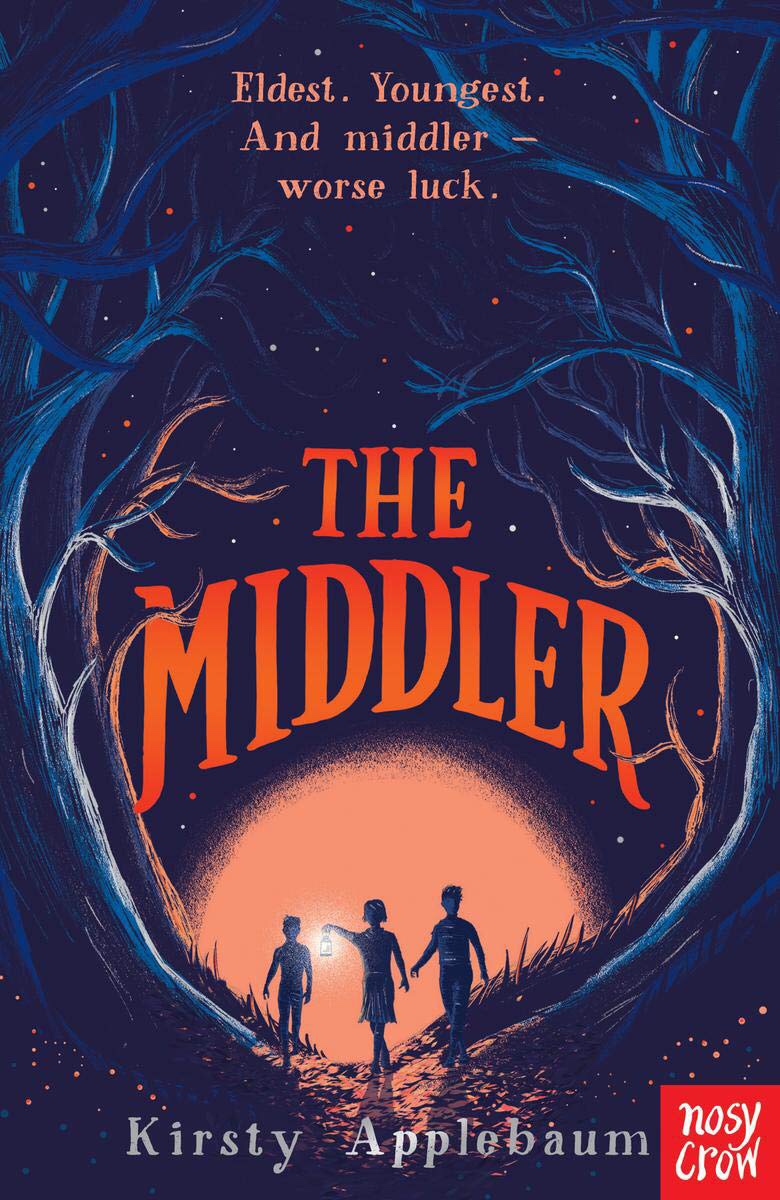
The Middler by Kirsty Applebaum

This debut set in a dystopian near future is an absorbing story of boundaries tested, forbidden friendships made, propaganda and questioning, and developing the courage to find your own voice and speak the truth.

Eleven year old Maggie is a middler, sandwiched between Jed, the eldest and Trig, the youngest, she feels invisible and unimportant. Jed is held in high regard by his parents, teachers and community in the same way as all the eldest children in Fennis Wick where Maggie and her family live. The inhabitants of this town are enclosed and protected from the outside world by a boundary. They are told that beyond this barrier the dirty, dangerous, deceitful wanderers roam and the Quiet War rages. As this quietly menacing and unsettling story unfolds Maggie and the reader discover that the eldest may not be being singled out for something special but for something sinister instead.

The voice of Maggie, the story’s narrator, is compelling and matures as the storyline progresses. It is her meeting with Una, a wanderer girl who is desperate for help that sparks the change. Trusting and innocent at the start of the book Maggie starts to question the rules and realises that she has been told lies for many years. There are many themes running through the narrative that resonate today. The boundaries are not only between places but also between people. The sinister controlling of people’s attitudes towards those who are ‘different’ or who do not conform is well written as is the creation of this alternative but believable world.

The adventure through which the themes are conveyed is tense, exciting and well plotted. There were a couple of moments when as a reader you want to hold your breath and the children’s courage will keep young readers gripped. The wonderful characters including Maggie herself, the lovable Trig and of course Una, the wanderer girl are engaging and believable.  When I started reading this book I wasn’t sure what to expect but was completely won over by Kirsty Applebaum’s exciting debut. This is dystopian fiction for middle grade readers with an understanding of what matters to children; family, friendship and being valued.

Thank you very much to the lovely people at Nosy Crow publishers who sent me my review copy. The book, published on 4th April, has a fabulous cover designed by Nicola Theobald that features artwork by Matt Saunders.


Posted in Book Review | Tagged , , , , , , | 5 Comments

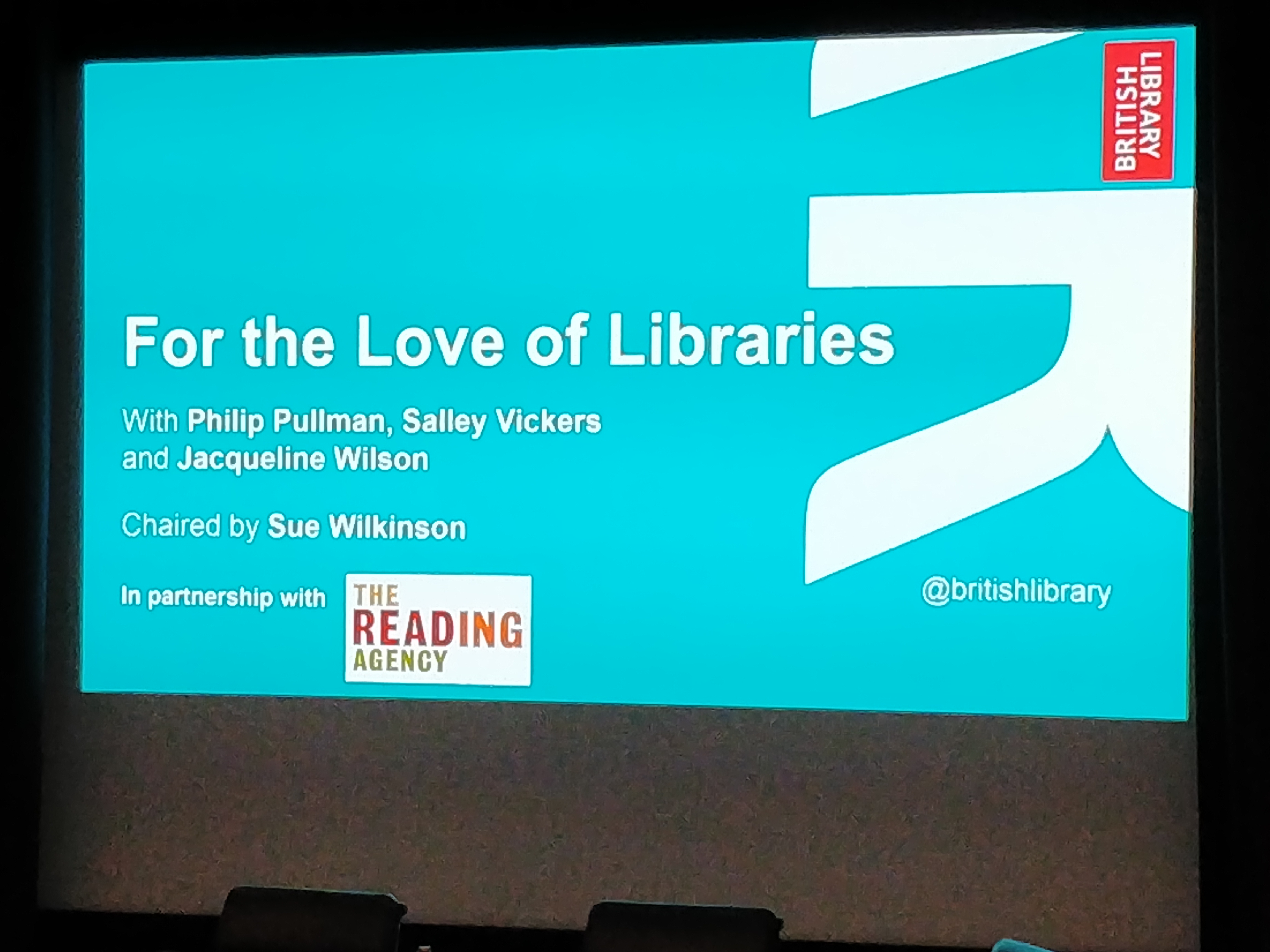
For the Love of Libraries

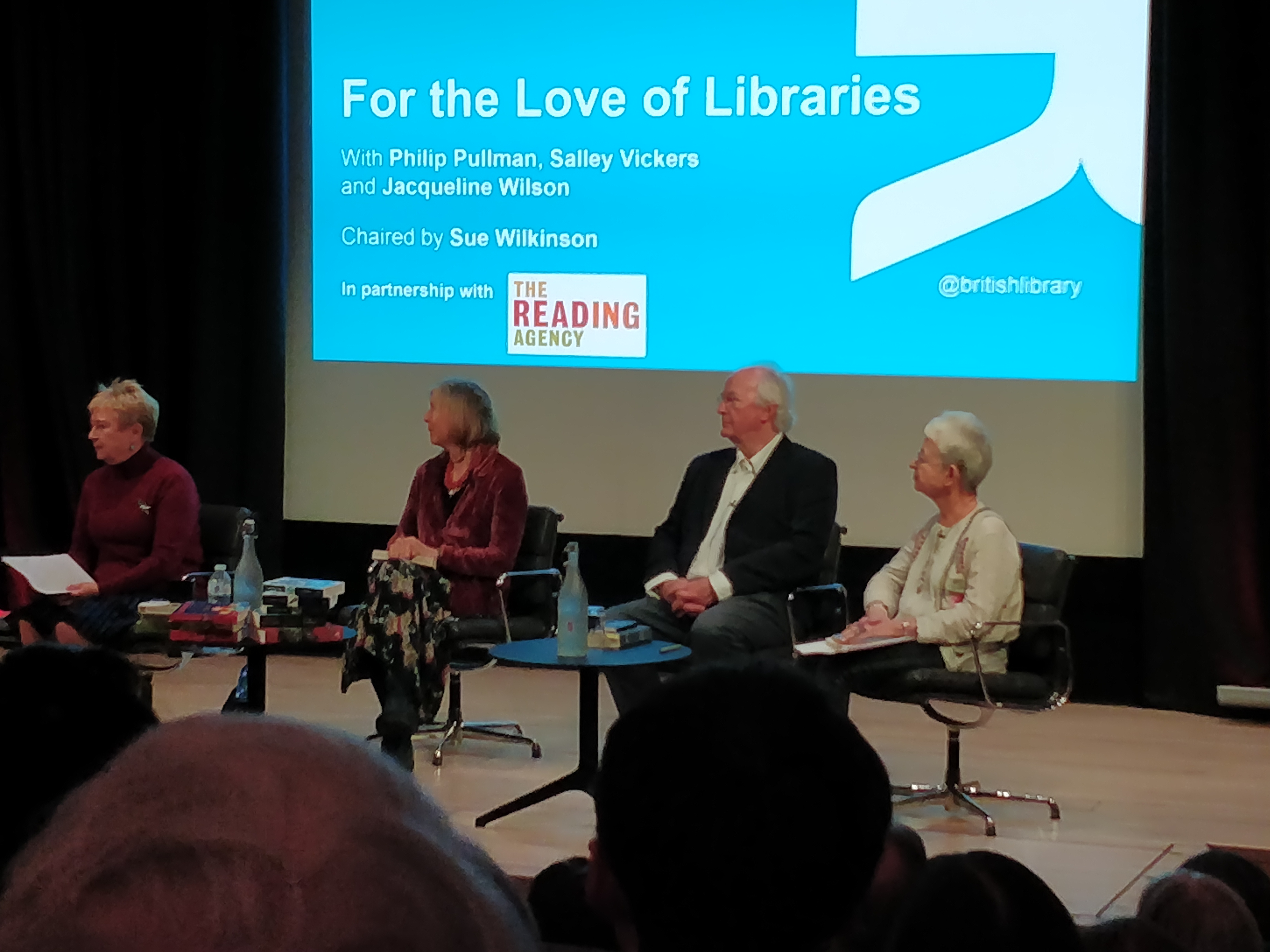
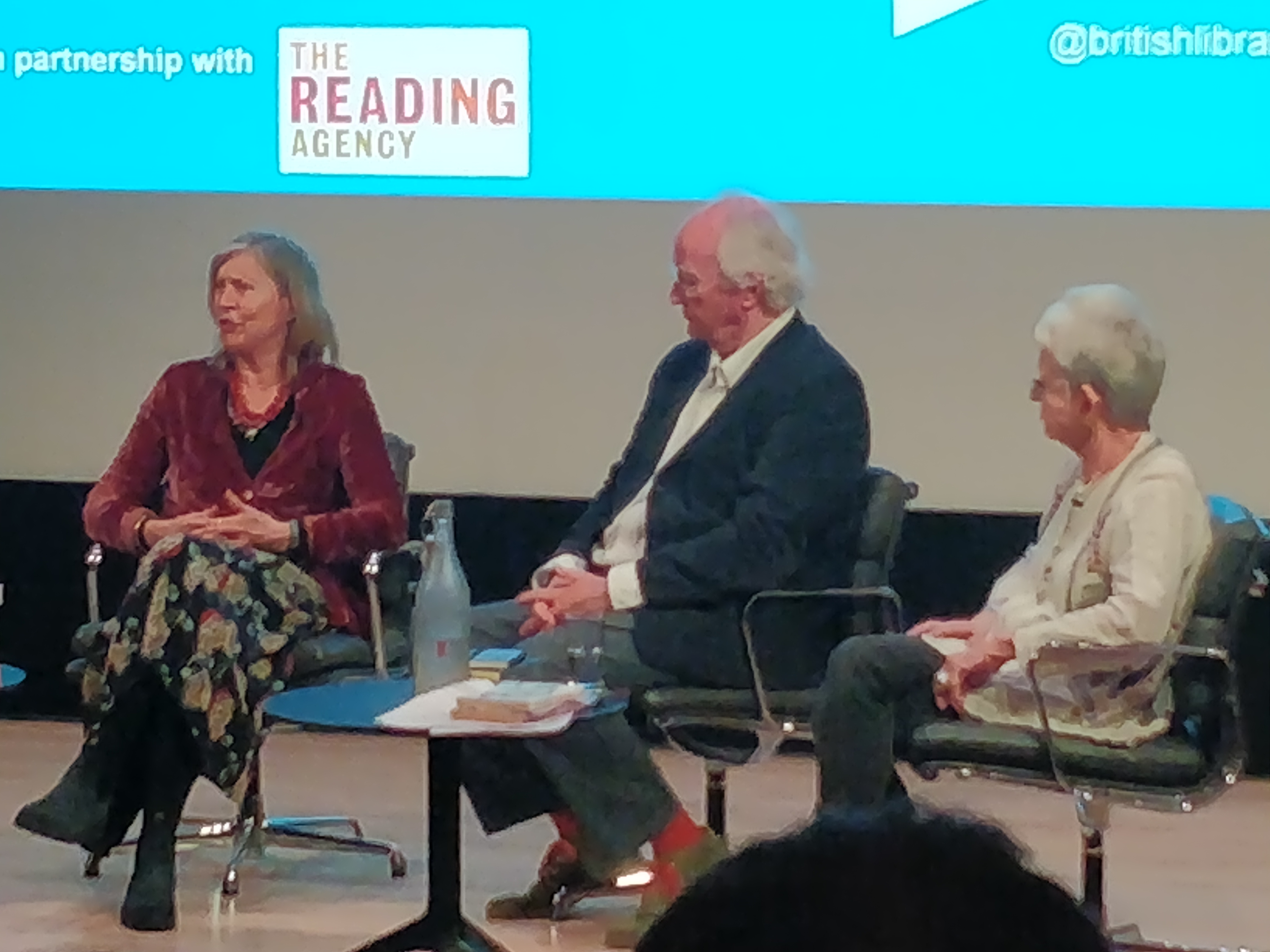
On Sunday 10th March I battled my way through gales, engineering works on Southwest Trains and fallen trees on Southern Rail to attend an event at the British Library. It was definitely worth it.  The afternoon brought together three wonderful authors, Sir Philip Pullman, Salley Vickers and Dame Jacqueline Wilson in a thoughtful discussion about the effect libraries had on them as children, as readers and as writers and, of course, why they love libraries.

IMG_20190310_145737.jpg

The discussion was chaired by Sue Wilkinson of the Reading Agency. She introduced the afternoon by explaining that as a body they work with many different partners but that one of the most important is libraries. She also went on to say that “personal choice creates readers.” Libraries help to provide that choice to everyone.

There were many important points raised and discussed during this event and I am still thinking about these several days later. There were some comments made that particularly resonated with me.

All three authors stressed how important it is that library usage and a love of reading starts in childhood. Philip Pullman said that if you develop a love of reading as a child you probably hang on to that love. Jacqueline Wilson told us that her mother obtained special permission for her to join the library as she was so young. Salley Vickers described the librarian after whom the lead character in her latest novel, The Librarian is named. The original Miss Blackwell displayed an impressive knowledge of children’s literature and an ability to know not just which book a child may want to read but also, perhaps more importantly, which book a child needed to read. This wonderful professional introduced Salley Vickers to The Moomins by Tove  Jansson, a series also beloved by Philip Pullman.

IMG_20190310_150408.jpg

Jacqueline Wilson had fond memories of graduating to the adult section of Kingston upon Thames library at a very young age and reading Jane Austen. Again there was a common thread as all three said that thanks to libraries and librarians they had been introduced to authors and books that otherwise they may never have known. This availability and range of choice is a key argument in the fight to maintain our public libraries. Without this access, this wonderful opportunity to happen upon literary gems almost by accident, reading could be a narrow and somewhat limited experience. Phillip Pullman said that the most popular area in a public library is the returns shelf. This comment was greeted by knowing smiles from the librarians in the audience! I think that his description of a library as “a treasure chest of serendipity” is just perfect. That feeling of wandering the shelves and discovering new worlds and new friends among the books is what I love most about libraries.

IMG_20190310_160743.jpg

Salley Vickers movingly described how a children’s book, The Owl Service by Alan Garner, brought her back to reading during a dark and difficult time in her life. She highlighted the social role of libraries commenting that the government could  be saving money on mental health if they invested in libraries. She also asked where better to find out about diversity than in a library? Libraries could be centres where literature and information are used for social benefit. Jacqueline Wilson summed this aspect up excellently with her description of a library as  “a place of refuge and of inspiration.” The library became her place, her home and somewhere that she was able to lose herself completely.

The descriptions of the writing process and the authors’ relationship with their books and their readers were fascinating. Often the author may not consciously be trying to express a particular point and sometimes meaning only really exists once the book is read. We all read in a subtlety different way and a story may be multi layered with different readers taking differing experiences from the book.  Salley Vickers expressesd the view that very good books can convey serious subjects through the imagination not through the mind. Philip Pullman voiced concern that in schools it is now harder for teachers to read aloud to children aloud simply for the joy of it and that often exercises or tests are linked to books read in the classroom. He said perhaps the best way to create a reader was to take a child into a library and allow them to choose. As a school librarian I agree that the freedom to choose reading material is key when encouraging reading for pleasure.

That public libraries are under threat has been well documented in recent years. Although Jacqueline Wilson has visited some wonderful examples of vibrant city centre libraries she also noted that the smaller library once found in every town is disappearing. As Philip Pullman so succinctly described it, “We must have libraries where people are.” If local town centre libraries shut then a mobile library service is even more vital. His own mobile library used by the elderly or young mums with toddlers in pushchairs who are unable to get to the city centre, has been removed. Sadly it appears to be that the places where libraries are needed the most are those where the service is cut.

Perhaps the final word should go to Dame Jacqueline Wilson, former  Children’s Laureate, who said.

”We must put our shoulders behind the campaign to preserve our public libraries.”

The packed theatre audience of library lovers wholeheartedly agreed.


Posted in Libraries | Tagged , , , , , , , , , , | Leave a comment

Children’s Books, Choice and Reading for Pleasure.

C8B96B5C-E4B9-4DD5-8703-10466DC019B0Which books do children read? The answer to this question varies according to which source of information you consult. A more pertinent question might be, which books do children choose to read? The announcement this week of the shortlisted books for the Children’s Book Award, the only national award where the titles are chosen entirely by the children themselves, is a very good indicator of which books children enjoy reading. I always find it fascinating to compare the lists for this award with the lists for other awards selected by adults. In the younger readers category in particular, books are often ones with plentiful humour or illustrations or sometimes a combination of the two. This year’s titles, FUNNY KID – STAND UP By Matt Stanton, MR PENGUIN – THE FORTRESS OF SECRETS Written and illustrated by Alex T Smith and THE DOG WHO LOST HIS BARK Written by Eoin Colfer, illustrated by P.J. Lynch are an excellent example of this trend. This is a wonderful selection and particularly so because the children consulted across the country to create this shortlist clearly value these books highly.
Coincidentally, this week an article appeared in TES referring to a recently published report that once again confirmed that  children reading for pleasure has a direct bearing on their attainment.  Everyone who is involved in any way with children’s books has known of this link between reading for pleasure and attainment for some time. However what do we mean by ‘reading for pleasure’? When I read for pleasure it means that I am reading something that I want to read, that I have chosen to read myself.  Children may choose to read a book for a variety of reasons but we know that motivation to read increases their engagement with reading. Therefore their choices are an important part of reading for pleasure. It may not always be a book that an adult considers a challenge or would have selected for the child themselves but children need to feel that their choice is a valid one or they may be deterred from choosing again. Learning how to be a reader involves a child in experimenting with different authors and genres to discover where their own tastes lie. Often primary aged children may choose a picture book, or a highly illustrated young fiction title or maybe a graphic novel. They may also select a book that is linked to a personal interest or hobby.  These are all “proper books”.

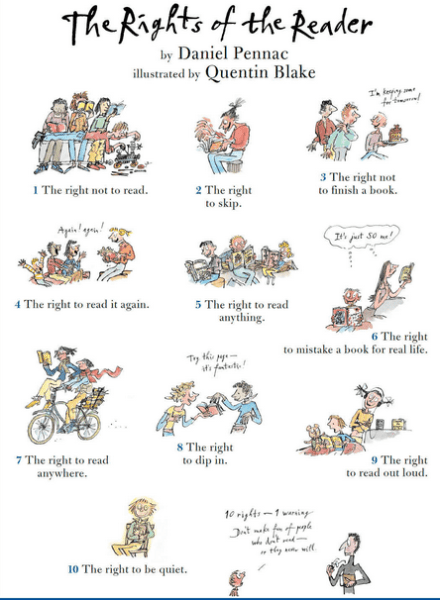
A40ACD06-0F16-4246-B0D0-1E68E2047A64As a school librarian I felt sympathy for a child who brought a carefully selected book back to the library the following day saying “Mum says this is too easy for me.” or “ I’ve been told I need a more challenging book.” It is of course possible that the child in question is easily capable of a more challenging book but surely it is preferable to respect their original choice and then nudge them gently towards something considered more appropriate next time. Seventeen years as a primary school librarian have shown me that illustrated books of all types are very popular with children all the way through primary school and beyond. Any concentration on books being ‘too easy’ or ‘too young’  may be linked to the following of reading schemes and levels but once a child is able to read independently they often want to revisit old favourites and read them themselves or simply read for fun. If we persist in describing reading as something that children should do or as something that is good for them in the same way as eating vegetables then we should not be surprised if they do not then see it as fun. If they are allowed to become involved in their reading progress by choosing books they like they are much more likely to feel that they are participating in an active and enjoyable way. The Rights of The Reader poster by Daniel Pennac and illustrated by Sir Quentin Blake summarises excellently the varies ways in which reading can be encouraged.

The books studied in the classroom or read aloud by a class teacher provide an opportunity for the child to experience a book in which the vocabulary or some of the themes may be too tricky for them to handle independently. It is then that their reading experiences can be stretched and guided further by the teacher and librarian working in tandem. Books borrowed from the school or public library or bought by parents provide an opportunity for children to choose for themselves, gain confidence in their ability to select books and develop their own identity as a reader. Perhaps choice could follow a discussion and books could be of varying types and levels of difficulty to widen the range available but nonetheless it is important to remember that children’s own reading choices are a vital part of  both encouraging reading for pleasure and creating true readers and therefore need to be valued.

Posted in Reading | Tagged , , , , , , | 1 Comment