Recent research has added to the belief that reading can help children and young people understand their emotions better and navigate any challenges that they may face. Since I read Abi Elphinstone’s debut, The Dreamsnatcher, ten years ago I have been struck by how well she incorporates this important aspect in her stories of magic and adventure. Awe and wonder, hope and faith are emotions many would agree have a positive impact and should be nurtured in our young readers. Goodnight Silver successfully combines a thrilling, magical adventure with a kindly encouragement to children to be courageous and optimistic even when life appears difficult or sad.
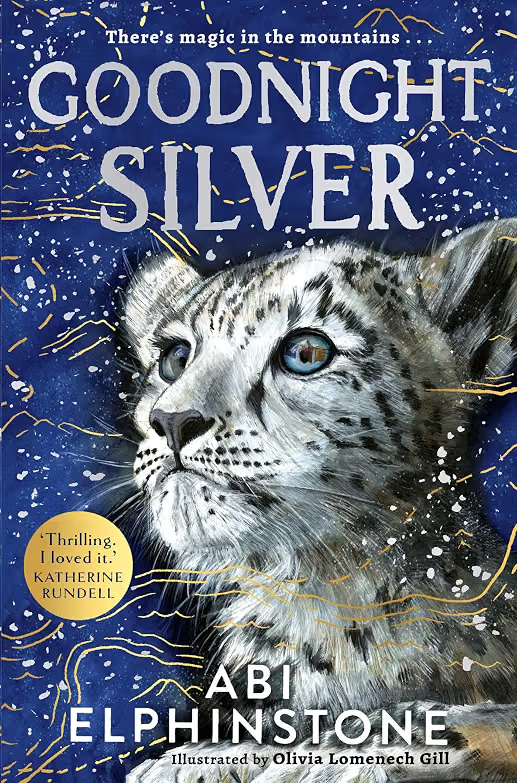
Emmy is a pessimist. She doesn’t believe in magic or miracles as her recent experience has shown her that looking forward to something with anticipation and love does not always guarantee that things will end well. She and her parents have travelled to the mountains of Mongolia on a much needed family holiday. Her parents are full of excited anticipation but Emmy is worried and anxious that things may go wrong. Emmy’s fears are fulfilled when she is separated from her parents in a blizzard and she is forced to take shelter in a cave. It is in this cave that an unexpected encounter starts to change the frightened girl’s attitude. There is another who has hidden there and from the darkness a lost snow leopard cub emerges who is drawn to Emmy and she in turn is reassured by the beautiful animal’s presence. She resolves to help him and maybe even find his mother. Then when the two of them emerge they meet a boy in the woods named Tuli who is bursting with joy, optimism and hope. Although initially overwhelmed by his exuberance Emmy gradually and tentatively allows herself to hope a little too. This lovely trio then embark on a quest to find a secret land named Whisperfell where the animals live in peace. But danger lurks nearby in the shape of a hunter who is closing in on his prey.
Abi Elphinstone’s own love of nature shines through her writing and this story conveys the drama and majesty of part of the natural world she herself knows well. For her readers this offers the opportunity to experience the drama and beauty of it through the eyes of Emmy and Tuli. The adventure flows naturally with episodes of drama interspersed with thoughtful passages about the importance of family and friendship. The reason for Emmy’s own worry and sadness is poignantly expressed but not dwelt on, allowing children just enough of a glimpse of personal grief to be able to understand her character a little better. The magic and danger of the quest will grip young readers and there are moments of great tension building to a satisfying and uplifting climax. Personally I do love the way in which Abi makes even an adult reading her stories believe in magic! This is joyful book full of love for our natural world but with a focus on enjoyment and nurturing rather than a fear of loss and destruction. Both Emmy and Tuli are characters who one grows to care for and as I said at the start of this review will help youngsters understand both others and themselves a little better.
Goodnight Silver is a magical adventure that will transport its readers to a world they may well want to visit too. The finished copy will be fully illustrated by Olivia Lomenech Gill and the sneak preview of one or two in my proof plus the stunning cover suggest this will be a beautiful book. Published on 27th October by Simon and Schuster Children’s Books. I would like to thank Ellie Curtis for kindly providing my proof copy.