Kate Greenaway Award 2018 Shortlist – Under The Same Sky by Britta Teckentrup

This charming picture book, shortlisted for this year’s Kate Greenaway Award, uses a clever peep through technique to emphasise the way in which everyone around the world is united by the same hopes and dreams. It is a timely and thoughtful book.

51Olap6vn7L._SX258_BO1,204,203,200_

Award winning illustrator Britta Teckentrup combines beautiful pictures with a simple yet lyrical text to portray a celebration of global unity in this lovely book. It gently depicts how the world’s communities are united by the same hopes and dreams.

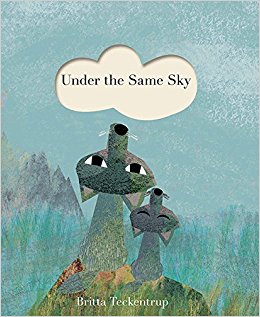
When this book was first published I was drawn to the cover without having known anything about either the author or the title itself. The cover depicts two animals on the front, one large and the other smaller, possibly a parent and child, both gazing upwards at a cut-out of a cloud through which one can read the title. One animal is wide eyed, the other with eyes closed and the overall look is serene and reassuring. As you turn the pages a variety of animals are portrayed in contrasting landscapes with each linked by a clever use of a cut-out through which the reader catches a glimpse of another animal or another place. This technique works beautifully as the connection feels natural and unforced. Despite the simplicity of the text the message of a world united by shared emotions is conveyed with great impact. Beautiful, gentle illustrations combine with the brief but slightly poetic text to demonstrate that we have so much that unites us rather than divides us and that we all share this one world together. In a time of political turmoil this is an important and timely message.

And yet despite the important message this is of course an engaging and lovely picture book that is a delight to share with young children. The interactive element is something that little ones always love and this is done very well as it invites them to peep through and maybe return to previous pages to see how the trick was done. I loved the way in which the shape of the cut-out tied in with the content. The colours are muted and gentle, in keeping with the warmth of the message in many ways. Many types of animals are included so children are able to recognise some and be introduced to others.

A lovely book and highly recommended for all ages from early years onwards.

As this book is shortlisted for the Kate Greenaway award there are a range of brilliant teaching resources available on the Shadowing website prepared by the Centre For Literacy in Primary Education. Please click on this link to access them.

You may also enjoy watching this interview with Britta Teckentrup.

Posted in Book Review, Carnegie and Kate Greenaway Award | Tagged , , , , , , | Leave a comment

Kick by Mitch Johnson

An extremely impressive debut, this book has at its heart a lead character with whom readers will readily engage. Despite his difficult and at times distressing life 12 year old Budi is a boy with friends, heroes, hopes and dreams just like youngsters his age the world over. This is an important story told in an accessible way and is highly recommended.

IMG_20180426_093829


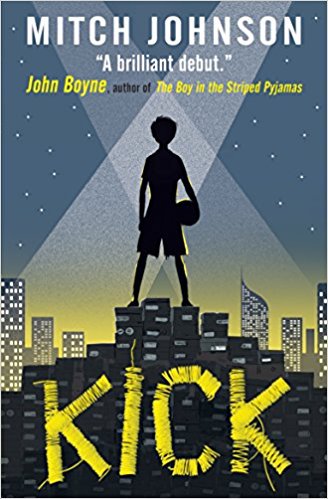
Budi is a football loving Indonesian boy living in Jakarta. He dreams of becoming a footballer like his hero, Kieran Wakefield of Real Madrid, and every evening he trains with his best friend Rothy and watches the important matches whenever he can. In many ways this could be describing football mad boys in the UK. But there is a big difference. Every day Budi works for up to 10 hours in a sweatshop making football boots and earning very little for it. The working conditions are harsh and some of the descriptions of the conditions are upsetting. But Budi has a quiet strength and humour which combined with a loving family help him to cope with his situation. Until one day, when playing football one unlucky kick changes things forever. Now Budi has upset The Dragon, the most dangerous man in the city and he may have to pay a high price for doing so.

Both the characters and the setting felt very real to me. Mitch Johnson has a knack of describing the heat, the smells, sounds and colours of the city in a way that brings them vividly to life. This is a world away from the life most of the book’s readers will know and the reality of this difference is important and sobering. Despite the poverty in which Budi’s family live and their shame at Budi’s uncle’s prison sentence this is a family that love and support each other. I particularly enjoyed the relationship between Budi and his storytelling Grandma. That love across the generations is an important part of family life and her stories contained pearls of wisdom.

As I read this I was repeatedly reminded of my own football loving sons. When they were Budi’s age they were in many ways so similar to him. Little things like the need to turn any everyday object into a football and the copying of their hero’s celebrations at their team’s successes were strikingly familiar. However I was also reminded of shopping trips to buy new boots and trainers. I despaired at the high price of these and as my sons grew taller and bigger the replacements were needed so often. I knew and had read about the manufacture of my boys’ favourite boots and although I tried to buy from reputable stockists there was a nagging worry at the back of my mind. My sons, now adults, have grown up in a very different world to Budi’s and have been lucky to be able to see their heroes play at Wembley and stadiums in Europe. For Budi this was a dream that is so unlikely to come true and yet he never gives up hope. His resilience and optimism is something that young readers can learn much from.

Kick is an important story that I will think about and remember for a long time.

This would be an excellent read for Year 6 age and above. It can be purchased in all good book shops, borrowed from your local library or bought online

It says a great deal that this special book has been endorsed by Amnesty International and a range of teaching resources and links to information about Amnesty’s work can be found on the website here.

Fairtrade is a simple way to make a difference to the lives of the people who grow and make the things we use. They do this by changing the way trade works through better prices, decent working conditions and a fair deal for farmers and workers in developing countries. Fairtrade have produced a range of resources to help teachers explain their programme to children. Among these are a film and presentation on The Story of  Fairtrade Footballs which would link well with Kick. The film can be found on the official website here.

Posted in Book Review | Tagged , , , , , , | 2 Comments

Children’s Books Helping Readers Find Courage

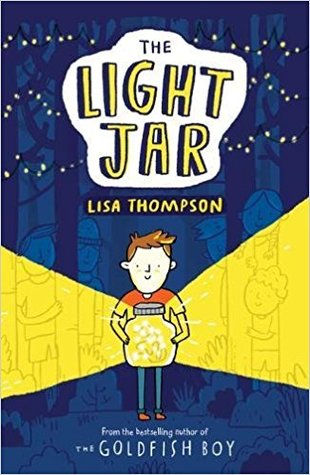
One of my favourite debuts last year was The Goldfish Boy by Lisa Thompson so I was very much looking forward to reading The Light Jar, her second novel, and I certainly wasn’t disappointed by this thoughtful novel about finding courage and friendship in unlikely places.

36535699

In the middle of the night Nate’s mum wakes him and together they drive away in the darkness to a tumbledown cottage in the middle of a forest. When Mum heads off for more supplies, and then doesn’t return, Nate is left alone and afraid. How will he cope? But then Nate discovers comfort can come from the most unexpected of places. He meets a mysterious girl trying to solve the clues of a long forgotten treasure hunt and an old friend reappears from his past too. Will they help Nate find the courage needed to conquer his fears?

Lisa Thompson shows some courage too by tackling the subject of domestic abuse in a book aimed at children of about 10 plus. Yet she conveys the situation with such care and sensitivity for her young readers that this subject is dealt with in an entirely appropriate manner for them.

This is another well plotted story by this author. Readers will enjoy solving the treasure hunt clues alongside Nate and Kitty and the air of mystery surrounding both the characters and the setting should keep children gripped. As the details of Nate’s family history are gradually revealed I grew to care more and more about him. As a Mum I just wanted to give the poor lad a hug. Although, thankfully, most readers will have no experience of his situation Nate is a character they will empathise with and learn from.

As a school librarian I’ve been asked by teachers and occasionally by parents whether I think difficult social issues are appropriate subjects for children’s books for this age group. When they are handled as well as this my answer would be yes. It is just possible that a book like this could offer help to a child in a similar situation and make a vital difference.  Also, reading about such subjects in the safety of the pages of a book is a learning experience for young readers promoting an understanding of and empathy with those with very different lives to their own.

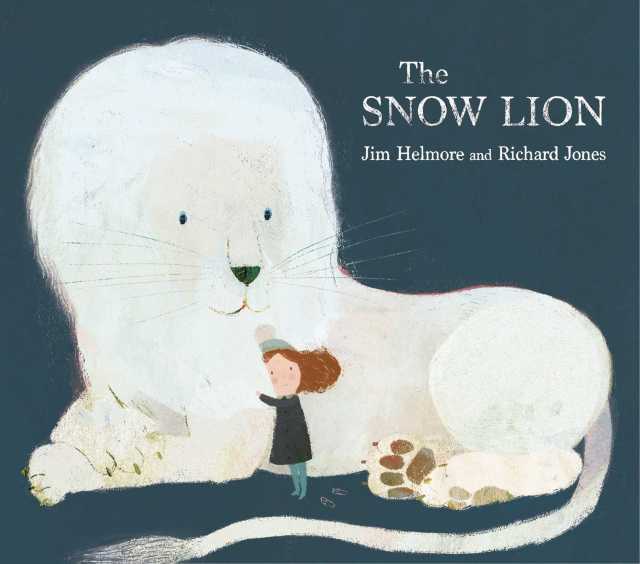
The opening of The Light Jar reminded me in some ways of the lovely picture book, The Snow Lion by Jim Helmore and Richard Jones. In this story Caro and her mother arrive at their new home in darkness. Once inside, the house is white, bare and empty. Caro wishes that she has someone to play with and feels a little lost and small. Then one day she hears a noise and a gentle voice asking to play. She has a new friend and a very special one. The Snow Lion has appeared as if by magic to help Caro learn how to make friends of her own and maybe find the courage she has been hiding inside.

the-snow-lion-9781471162237_hr

Although we are never told why Caro and her mum have moved house both Nate and Caro find courage and friendship in ways that are reassuring to and understood by children. Class teachers may find a study of the differing ways in which these books depict this and the comparisons between the two interesting.

These books have made me wonder if children’s stories act in a similar way to an imaginary friend, being a reassuring guide to young readers, helping, comforting and walking alongside them as needed as they learn about life.

Posted in Book Review | Tagged , , , , , , , | 1 Comment

I’m looking for a book about… Shakespeare for Primary School Children

Shakespeare’s birthday is remembered on 23rd April and this is a good time to introduce primary school children to the Bard.  There are several websites providing resources to enable teachers to produce lessons about some of his greatest plays and I have linked to a couple at the end of this post. However there is also a great selection of books available for children to read themselves that provide a taste of both the man and his work. Here are just three that I think will kindle an interest that can be built on later.

Mr William Shakespeare’s Plays by Marcia Williams

Marcia Williams has written and illustrated numerous books for children and many of these have been re-tellings of classic stories, illustrated in her distinctive cartoon-strip style. In this book she presents seven of Shakespeare’s classic plays, including Romeo and Juliet, A Midsummer’s Night Dream, Macbeth and Julius Caesar, in this accessible format. The dialogue boxes include quotes from the plays making this an excellent introduction to the language.  The wonderful illustrations and humour add to the appeal.  This engaging book is the perfect place to start an interest in Shakespeare.

What’s so Special About Shakespeare? by Michael Rosen

The style and format of this biography of Shakespeare by former Children’s Laureate, Michael Rosen, has great child appeal. Presented in clear sections and answering questions such as ‘What was it like to live in Shakespeare’s time?’ plus a helpful timeline, this book encourages children to browse and discover. Sarah Naylor’s illustrations add to the appeal and readers will learn both about Shakespeare’s life and have an introduction to some of his plays including King Lear and The Tempest. This is a book that has been a hit in the school library.


The Boy and the Globe by Tony Bradman and Tom Morgan-Jones

Last but not least this lively and enjoyable story published by Barrington Stoke combines fact and fiction wonderfully.

Set in early seventeenth century London where young orphan Toby Cuffe is living on the streets.  In order to survive, the resourceful Toby joins the gang of boys who work for Moll Cut-Purse as thieves. Moll sends Toby to the Globe Theatre to do some pick-pocketing where Toby becomes so engrossed in the play being performed that he forgets about his own safety. Caught by the theatre’s owners Toby meets the writer of the play he has just seen performed, the famous playwright William Shakespeare. Then our young hero is given an opportunity that he had not expected and he rekindles the Bard’s enthusiasm so that together they team up to save the threatened theatre.

There is enough historical detail to give a sense of time and place and yet this exciting story never has the feel of a history lesson. By depicting Shakespeare as a world weary man with writer’s block and a wish to go home to see his family Tony Bradman cleverly brings him to life in a way that children will probably enjoy. The wonderful illustrations by Tom-Morgan-Jones, slightly cartoonish in style, work well with the text too.

This book has the added attraction of funne activities for boys and girls at the end of the story. These include double page spreads of both London and The Globe with items for readers to spot, some Shakespearian insults to try out on your friends and guidance on making your own puppets

All of the books above should be available at good bookshops or your local library.

There are also many websites with resources to help teachers engage children with Shakespeare and his plays. One of the best for the primary age group is Shakespeare Week. Click on the image to visit their website.

Shakespeare Week

James Clements, an educational writer and researcher, has created an extensive website providing units of work for several Shakespeare plays and many downloadable resources. It can be accessed here.


Posted in Teaching | Tagged , , , , , | Leave a comment

Eleanor Oliphant is Completely Fine by Gail Honeyman

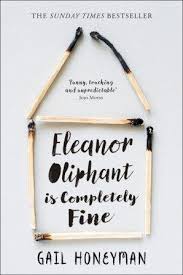
Over the weekend I read Eleanor Oliphant is Completely Fine, the debut novel by Gail Honeyman. I adored Eleanor and her voice will stay with me for a long time. This is a moving story told with humour and care. It is also a timely reminder, if one were needed, that even the smallest acts of kindness can make a big difference.

E Oliphant cover

When I was a member of a book club whenever anyone recommended an ‘’award winner’’ as our next read I would stifle a groan. There is absolutely no logical reason for this bias of mine. As a school librarian I regularly used award shortlists to help me select library stock and often read and enjoyed them too. Yet my inner child clearly views adult award winning novels as something I ‘’should’’ read rather than something I want to read for pleasure. Eleanor Oliphant is Completely Fine won the 2017 Costa Award for a Debut Novel. It is a worthy winner. It is also, I think, a hugely enjoyable book.

I was instantly hooked from the opening pages and found Eleanor an intriguing and very unusual character. She feels so very real that it is almost a little unnerving. Eleanor leads a solitary life, working in an office all week and retreating to her flat at weekends when, following a pizza from Tesco, she will speak to no-one until she returns to work on Monday morning. A creature of strict habit, including drinking two bottles of vodka over the weekend, she is efficient and diligent but does not interact with her colleagues at all. Gradually the author reveals small details about Eleanor’s past and as a reader I grew to be interested in her back story and to care increasingly for Eleanor’s well-being.  The subject of loneliness, which is more and more often being highlighted as a modern day problem, is tackled with great care and perception.

As the story progresses Eleanor’s timetabled and orderly life starts to unravel and yet at the same time her connections with others start to increase and slowly, so slowly, Eleanor learns to trust and to hope that change may be possible.

I found this a moving, thoughtful and ultimately a hopeful read. Eleanor is at times frankly hilarious. She is an intelligent woman and her observations of social behaviour are spot on. One of the most lovely aspects of the book is the kindness shown by others and watching its effect on Eleanor. It really made me think that when we are out and about in our daily routines we have no idea what others are having to cope with and endure. I will try to remember that next time I get exasperated by trivial things.

School librarians and teachers often stress how important reading and books are in developing empathy in children. Eleanor Oliphant does a pretty good job at doing the same for adults.

This book can be purchased from all good bookshops, borrowed from your local library or bought online

The Reading Agency has a scheme called Reading Well that helps people to understand and manage their health and well-being using helpful reading. This includes providing titles to help those suffering from common mental health problems.


Posted in Book Review, Reading, Uncategorized | Tagged , , , , , | Leave a comment

The Explorer by Katherine Rundell

The Explorer by Katherine Rundell is a hugely enjoyable read. Wonderful writing brings a vivid world to life, creating a gripping adventure and convincing characters who develop and grow. This award winning novel combines excitement and quiet thoughtfulness. I loved it and would highly recommend it to young readers.


When four children find themselves abandoned in the Amazon Rainforest following an air crash they are forced to pull together as a team in order to survive. Without adult help they must rely on their own limited knowledge and initiative to cope with threats from snakes, piranha, tarantulas and much more besides. The children, Fred who has always found the idea of exploration exciting, prickly and irritable Con and brother and sister Lila and Max gradually learn that they can be braver than they ever imagined.

Katherine Rundell has a gift for creating a world that feels real in her stories and in this book she has drawn on her own personal experiences of the Amazon to do so. This book is packed full of information wrapped up in a very exciting adventure. Readers will learn how important it is to value our environment and to care for it responsibly. Although the story is set many years ago this message definitely has a relevance today and will open children’s eyes to the beauty of the wider world.

The characters are wonderful in their realistic feel, displaying emotions that you would expect such youngsters to feel. Poor snotty little Max is whiny at times, Con gets irritated and angry, Fred makes some mistakes and Lila is so fiercely protective of Max that she may not understand the others attitude to him. As the story progresses these children develop and mature in a manner that young readers will learn much from. There is a sensitivity to the story that runs through all the trials and adventures the children endure.

This is the sort of book that I would have lapped up as a child and even though I’m long past being in the target age group I still loved it. A remarkable story, beautifully told this deserves to be in every school library and classroom.

The Explorer can be purchased at all good bookshops, online or borrowed at your local library.

From a teaching point of view this would work brilliantly as a read-aloud in the classroom and also to link with the topic of the rainforest or conservation. The publishers, Bloomsbury, have kindly created a resource pack for teachers which is freely downloadable here

Katherine Rundell has also featured in an interview talking about the inspiration behind the book.

As a school librarian I have collected a selection of links to websites on the topic of rainforests which may be helpful in the classroom for research projects or to provide more background information linked to The Explorer. Please click on the images below to visit the relevant websites.

MGBnet RainforestThe Missouri Botanical Garden website – rainforest information for children


Posted in Book Review, Teaching | Tagged , , , , , , , , , | 2 Comments

My Mum, Books and Me – A Reading Legacy

“Children are made readers on the laps of their parents.”

                                                      Emilie Buchwald

This is such a well known quote about a child’s reading journey. Book lovers know and understand this. We encourage and promote it. Teachers and librarians pass on this message often and with great commitment. We quote research. We reiterate that reading for pleasure aids academic success. We confirm that reading attainment is positively affected by parental involvement at home in sharing stories and encouraging reading. Usually we concentrate on the academics. But reading is not only about that. Reading is about love. Especially in families. Perhaps we should be concentrating on that a little more.

I honestly can’t remember a time in my life without books, without stories being read to me or me curled up reading to myself or maybe aloud to my younger sister. There are however some landmarks in my reading journey that I remember vividly. When I was very small my mum used to disappear on Saturday mornings to go into town to have her hair done.  She would return on the bus with her shopping bag bulging. I can still remember crouching down on the rug in the hall to peep into the bag. I knew there was treasure hidden in the bottom of the bag. A Ladybird Book. A small hardback piece of magic. My favourite from that time was Mick the Disobedient Puppy, the tale of a naughty black poodle who ultimately saves the day for his owners. My sister has fond memories of Tiptoes the Mischievous Kitten. My mum would read these aloud to us and as time passed we were able to read them ourselves. These little books were a highlight in my week, bought and shared with love and remembered now with nostalgic affection. They were part of the fabric of my family life and not just a tool to help me learn to read better.

When I was a little older, about ten or eleven, my Mum said that she thought I might be ready to read one of her own favourites from childhood. She said it had been a present from her older sister who coincidentally had given  me my much loved copy of The Lion, the Witch and the Wardrobe. Mum then handed me a fat, rather battered looking hardback book with slightly discoloured pages. Each page was covered in rather dense looking text but there were some beautiful colour illustrations too. It had, I thought, a rather ‘grown up’ look to it. The book was Little Women by Louisa M Alcott. I tentatively took the book, honestly not sure what to expect. Although very different to anything I had read before, I became engrossed. The language and content bore little resemblance to my own life but something about it touched me. I think it was partly that I knew my Mum had loved it. The handing on of this story about a mother and her daughters felt a little like a rite of passage. I wanted so much to be like Jo, thought that my Mum probably liked Meg best and we both agreed that Amy was infuriating. We talked about the book together and I went on to read the rest of the series, Good Wives, Little Men and Jo’s Boys. By the time I’d finished I had decided that when I grew up I was going to start an orphanage or school just like Jo. My Mum smiled wryly when I told her. This was a story shared and loved together.  It was to introduce me to other classic novels and confirmed my experience as a ”reader” that would eventually lead me to seventeen happy years as a school librarian sharing stories with children and passing on the right book at the right time, just as my Mum did for me.

Just before Christmas I noticed that there was to be a TV adaptation of Little Women shown over several nights. When I next visited my parents’ home I told Mum all about it. We looked forward to it with eager anticipation and hoped that it would do justice to the book we both had such fond memories of. Since April of 2016 my Mum had been unwell with long periods in hospital and was now bedridden so her world had rather shrunk but she loved conversation, having a giggle and watching her favourite programmes on TV so this was to be, we hoped, a happy Christmas highlight. We were not disappointed. I recorded the episodes so was a little behind her experience of them. When I phoned or visited I begged Mum not to tell me about them until I too had watched them. Then we had a happy half hour after each episode had been watched by both of us dissecting the portrayal of the characters, the suitability of the actors and much more.

Afterwards I said it had made me want to reread the books. Poor Dad was dispatched to search cupboards to retrieve them and after a bit of repair work I carefully took the two volumes home.  The books, Little Women and Good Wives, with my Mum’s signature in the front, were back on my bedside table almost fifty years after they first found their way there. Over the next couple of weeks I reread Little Women and each time I visited my Mum I told her where I was up to in the story. I confided that I now identified much more with Marmee but still thought Jo was a wonderful character. We giggled over Amy and the episode of the pickled limes. We sighed over the fact that any rereading is slightly marred by the knowledge that Laurie will finally end up married to Amy. Why? How? This was much more than just a book that I had once read, it was a shared experience, a conversation about people, life and love.

I hadn’t started my rereading of Good Wives when my Mum became ill again. Life then became too busy and stressful for any reading really. My lovely Mum died in January surrounded by her family and surrounded with love. I still can’t quite bring myself to start rereading Good Wives but I will.

I have a huge number of reasons to be grateful to my dear Mum but right up there high on the list is the way she shared her love of books with me and encouraged my sister and me to read with joy. Reading is about so much more than test scores, academic achievement and success. It’s about living, learning and, of course, about love.

057_01

Posted in Reading | Tagged , , , , , , , | Leave a comment

Sky Chasers by Emma Carroll

Magpie is an orphan living off her wits as a pickpocket in the back streets of Annonay in France when a chance encounter with a boy dangling from the sky changes her life forever. She goes to the rescue and finds herself afloat too and for the first time ever she forgets about hunger and cold and feels strong, brave and truly alive. By impulsively rushing to help Pierre, Magpie finds herself involved with his family, the Montgolfiers, who are in a race to be the first to invent a flying machine. As events unfold Magpie and Pierre are sucked into a world of danger, spies, duels and royalty.

Sky Chasers cover

Inspired by Neal Jackson’s winning entry to The Big Idea Competition in 2014 this is an exciting adventure full of thrills and intrigue but hope, determination and friendship too. Emma Carroll’s skill as a writer ensures that she makes historical events from more than two hundred years feel fresh and relevant to today’s young readers.

Set in 18th Century France at the time of Louis XVI this enthralling story has a simply wonderful cast of characters, both human and animal.  Magpie and her pet rooster, Coco and Pierre and his much loved duck, Voltaire, are endearing and entertaining and their developing friendship and growing trust is well written and believable. I love Magpie. She is intelligent, resourceful, brave and despite her background kind and caring too.  As the story progresses the way in which Magpie quietly observes and learns from things around her means that the reader accompanies her as she discovers scientific details that will help in the family’s quest to be the first to soar into the sky. This is a fabulous way of incorporating science into children’s fiction and readers will learn the basics of flight without realising it.  There is a wonderful baddie too and she and the clever plotting and secrets gradually revealed add to the suspense.

The author’s attention to historical detail, as ever, is great and the book brings to life a period of history that today’s children probably know little about.  The inclusion of Marie Antoinette is brilliantly and amusingly done. I think this story would encourage children to find out more about the period, an added bonus of good historical fiction for this age group.

Emma Carroll incorporates the underlying themes of loyalty and a sense of belonging with care and this is a thoughtful read in addition to an exciting one. This is a must have for primary school libraries and classrooms, ticking all the boxes.  For various reasons I had been suffering from a bit of a reading slump and this book, although for children, engaged me and got me back on track so I’m grateful to Emma for that too.  This is a great book for ages 8 – 80.

Last but definitely not least a word of thanks to David Litchfield for the fabulous cover which captures the spirit of the story so well.

Another fabulous historical novel by Emma, this time set in World War Two, is Letters from the Lighthouse which I have reviewed here


Posted in Book Review, Reading, Uncategorized | Tagged , , , | 4 Comments

Here We Are – Notes for Living on Planet Earth by Oliver Jeffers

Oliver Jeffers’ latest picture book is a tender guide written to his newborn son to help him make sense of the world around him. This lovely book is also a short but thoughtful essay on what makes our global community work and would be treasured by older children and adults too.

image

Being a brand new parent can feel very daunting. That moment when you arrive home from hospital with a tiny scrap of humanity for whom you have total responsibility is overwhelming. This little person is on a voyage of discovery with you as the guide. Becoming a new father prompted author and illustrator Oliver Jeffers to create a manual for his baby boy that would answer some of his questions and start the little chap on his journey. His thoughtful guide is full of kindness, humour and wisdom which make this lovely book something to treasure. It would be a beautiful gift for new babies and new parents.

The opening pages start in space and we then zoom in to planet earth, which looks rather small and vulnerable. But then our tour of the planet begins and we see how beautiful and precious earth is, from the mountains (with pointy bits) and hills (bumpy bits) to the sea full of wonderful things and then back out to the sky which is blue (sometimes) and the stars and constellations. The illustrations that accompany the tour are full of fascinating detail. We learn about people and that one people is a person and more importantly that although people come in many shapes, sizes and colours and may look very different they are all still people. The fabulous double page spread that accompanies this message is worth spending some considerable time over. The diversity is wonderful, from a nun to a sumo wrestler, from a gay wedding to a woman in a burqua, from a boy in a wheelchair to the queen, this is a celebration of differences.

image

An equally lovely double page spread depicts the world of animals of every type with the words: “They can’t speak, though that’s no reason not to be nice to them.” Oliver Jeffers advises his son that he will learn language and an understanding of lots of things and then it will be his turn to pass on knowledge himself. Meanwhile he must remember that time often goes quickly, he should look after planet earth and most importantly of all remember to be kind. If he still has questions there are many, many people he can ask.  The book ends with the positive feeling of us all being part of an understanding, global community. In our present troubled world this is a moving and thought provoking message.

I loved this book and think it is a must have for primary schools as in addition to being a beautiful book to share read aloud it would prompt interesting discussion among older children too. It is one of those rather special picture books that resonates with adults too.

You may like to watch the lovely official trailer

Oliver Jeffers has written and illustrated many picture books and if you would like to try one that is completely different to Here We Are I would recommend This Moose Belongs To Me 

Posted in Book Review | Tagged , , , , , | 4 Comments

Tried and Tested Magazines and Newspapers for Primary Schools


When encouraging children to read for pleasure it is important to remember that they should be able to choose their reading material whenever possible. This choice may not always be the latest award winning novel but perhaps a magazine, comic or newspaper. Good school libraries always have several of these available for pupils as they can be the key that opens the door to the world of reading. The following suggestions have all been enjoyed, shared and valued by children in my care as a school librarian. I am passing on their details in the hope that they will be equally successful in your school library or classroom.

WRD Magazine

image

WRD is a magazine all about books for children between 8 and 14 years old. Originally known as tBkmag, but rebranded as WRD in 2013, it is wonderful for keeping up to date with children’s books. It is full of extracts from the latest books, author Q&As plus loads of assorted features and activities. I used this in the library frequently to help give pupils a taste of books or authors that may be new to them. A couple of extracts read aloud often encouraged children to be more adventurous in their reading choices and it is extremely helpful for librarians and teachers alike. Sometimes it provided reading material for those who had left their reading book at home too!

From 2018 WRD will be published three times each year in March, July and October. It is available singly (from£45 per year)  or in packs of four for schools (from £49.50)  so can be distributed around classrooms if required. I would highly recommend this. More details are available on their website here.

The Week Junior 

image

The Week Junior Magazine was launched in 2015 and is aimed at children aged between 8 and 14. This is designed to help children to understand current affairs and the world around them. 

It is packed with news on a wide range of diverse topics covering everything from nature, the environment and  science to politics, sport and technology. It also includes reviews of books, films, video games and apps. The information is presented in a very child friendly way but provides valuable information too. The weekly debate page is invaluable for sparking class discussion and I loved sharing this with children in the library.

Weekly issues cost £1.20 in the shops but special subscriptions for schools are available from £53.33 for one issue per week. More information is on the official website.

Storytime Magazine

image

This monthly magazine is fabulous for younger children. Each month, Storytime magazine is packed with wonderful stories for children including fairy tales, myths, fables, stories from different cultures and tales from new authors. Accompanied by bright and cheerful illustrations and puzzles, games and activities this is a very appealing package. Perfect for reading aloud sessions in KS1 and lower KS2 this is a useful resource for teachers and the publishers have now created a range of teaching resources to accompany the magazine. There are more details of these and the various subscriptions available to schools on the website.

Anorak Magazine 

image

Anorak Magazine, published quarterly and known as  the ‘happy mag for kids’ is aimed at boys and girls aged between 6 and 12 years old. Published on recycled paper this has a subtly different look to other magazines for this age group. I think this is a refreshing change and children appeared to think so too.

Each issue has a theme (inspired by the British National Curriculum) to inspire and encourage children to tap into their natural creativity and learn while having fun. Every edition has plenty of beautifully illustrated stories, games and activities to inspire and encourage. A one year subscription costs £25. If you would like to find out more visit the website.

Discovery Box 

imageFirst published in 1996 this educational magazine for children aged 9-12 includes a wide range of subjects including nature, science and history. Animal topics are presented through spectacular photos and informative facts. Important historical events are retold in story format and in a lively and engaging way and science articles present the great innovations and inventions using clear explanations and captioned pictures.  There are comic-strips, DIY activities, games, quizzes, recipes, pet care, and competitions to attract and engage. I think this is more suitable for young readers who may be put off by a lot of dense text.

Ten issues a year cost £50 and can be ordered via the website.

Aquila Magazine

image

This long standing  monthly magazine needs no introduction. Described as “the ultimate intelligent read for inquisitive kids” it is full of interesting articles and challenging puzzles that will get the whole family involved, every issue covers science, history and general knowledge. AQUILA is beautifully illustrated throughout with contemporary artwork.

Despite the increase in competitors Aquila remains a valuable addition to the primary school library or classroom. The content complements what children are being taught and can inspire them to discover more. The topics covered can link together what children are learning in maths, science, history and English. The magazine was originally conceived with the aim of challenging the gifted and more able child and it continues to do so.  Details of subscriptions and multi-buy savings are available on the website.

First News

imageHugely popular and widely used in schools this award winning weekly newspaper for children is aimed at 7 to 14-year-olds and encourages them to read about the news in an easy to understand and non-threatening way.

It cover issues which are relevant to children and which specifically affect them. There is  a mix of world news and UK news, but also loads of fun stuff, such as entertainment, games, animals, sport and puzzles. The editorial team try to provide a balance of happy, positive stories together with the more hard hitting items in the international news.

There are a range of subscriptions available for schools on the website.

The Phoenix Comic

The phoenixLast but not least is this brilliant weekly comic. As soon as the first copy arrived in the school library I knew I was on to a winner. The Phoenix is a weekly comic with high quality content and no 3rd party adverts that is suitable for girls and boys aged 6-12.

I have a soft spot for this great magazine as I have on several occasions spotted children, who are normally reluctant to read, curled up in the library engrossed in this. It engages through a mixture of stories, information and humour all conveyed with wonderful illustrations. This is a valuable addition to every primary school library and would be useful in the classroom too. It has also inspired children I have worked with to create their own comics too. It is fabulous.

To find out more visit their official website.

Perhaps one of these magazines will encourage your children to read for pleasure. I do hope so.


Posted in Reading | Tagged , , , , , , , | 1 Comment