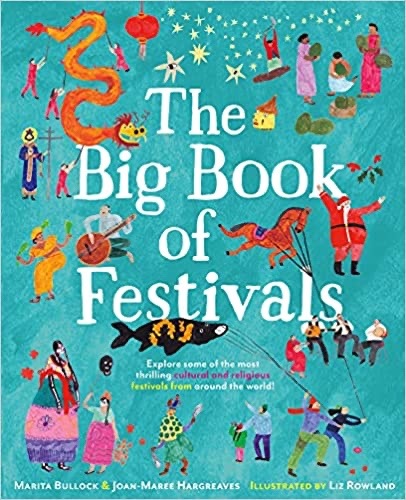
The Big Book of Festivals is crammed with information and facts celebrating the diversity of the world’s celebrations and the importance of them to our sense of community. A joyful look at the way people mark special occasions expressed in an accessible text and colourful illustrations detailing the symbols and motifs associated with the different occasions.
This book would be an excellent introduction to the cultural and religious festivals of the world and a valuable addition to school library and classroom bookshelves. Presented in alphabetical order and providing full descriptions of each festival, its history and where and when it takes place The Big Book of Festivals is wonderful for both browsing and structured learning. The accompanying illustrations and their captions highlight particular aspects of the festivals and make each double page spread appealing to linger over. There are thoughtful touches such as individual named children introduced at the start of the book for the reader to lookout for as they read. The endpapers deserve a mention too as they depict a map of the world showing people in different countries enjoying the festivals described.
The various festivals include Diwali, the Indian festival of light, the Spanish tomato-throwing festival La Tomatina, Christmas, Hanukkah, the Belgian Festival of Giants, the Lunar New Year and Gelede the West African tribute to mothers. There are sections covering seasonal festivals too such as Thanksgiving and Groundhog Day and regional festivals including the Irish Puck Fair. The range is interesting and informative providing a look at the global nature of festivals and highlighting the shared aspect of joy and celebration.
The Big Book of Festivals was published on 1st February by Faber and Faber and I would like to thank the publisher for my review copy. You can purchase a copy of the book online at Bookshop.
Dido is back, and so is the breathtaking action of the first instalment, Race to the Death. However this enjoyable and stirring adventure is really about family, the bonds that bring individuals together in a shared endeavour not only to survive but also to win and maybe to forgive and to love too.
Dido is the only girl ever to have raced to victory at the Circus Maximus in Ancient Rome. Chariot racing was big business and hugely popular but also a matter of life and death. In this sequel set in AD 38 we watch as Dido, now in hiding from the Emperor Caligula and with a price on her head, takes on new challenges and displays both courage and determination but loyalty and understanding too.
Within a few pages I was immersed in the vivid world created by Annelise Gray and once more willing Dido on in her battles to follow her dreams. She is a fabulous character, likeable but determined, strong but kind, and utterly compelling. The carefully plotted storyline, full of thrills, danger and secrets, engages the reader completely and the mix of real people and historical facts with the excitement and drama gives Rivals on the Track an authenticity that encourages you to feel part of the events as they unfold. The horses, particularly Porcellus and newcomer Jewel, are an important part of the story too of course and horse loving readers will lap this up. The relationships between the characters are developed further in this second story and the growing maturity of Dido and the family dynamics provide moments of thoughtful tenderness balancing the excitement well. This, I think, ensures a wide audience appeal. There are new friendships forged, old rivalries resurface and running through all of this is one family trying to overcome past hurts and bitterness. It is always the mark of a successful story when the reader does not want to say ‘goodbye’ to these new friends as you turn the last page. I’m very much hoping it’s ‘see you again soon’ instead.
The fascinating characters are at the heart of this story’s appeal, especially the wonderful Dido, but what makes this book work so well is the historical detail that brings the characters and their surroundings to life in such stunning fashion. Therefore I am especially delighted to welcome Annelise Gray to the blog today to tell us a little about her meticulous research for the Circus Maximus series and to provide her advice on writing a historical novel.
Why I love historical research and 3 tips for writing a historical novel by Annelise Gray
I am never happier than when in a library. The smell of books, the sound-muffling carpet underfoot, the bleeping sound as the librarian checks out volumes under a scanner – all make me feel incredibly contented. I wander around the stacks, clutching a scrap of paper scribbled with shelf marks and return to my desk, laden with the next batch of volumes to be pored over and mined for glimpses of gold.
When I was in my twenties, I worked as a professional researcher for hire. After finishing my doctorate in Classics in 2004, I had little idea of what to do next. I knew that I wasn’t cut out for academia and although I’d really enjoyed my experience of teaching in a local school over the previousthree years, I felt that I needed to try something different to see if that was a path I’d want to come back to. So I handed in my notice at the school in the hope that by taking a leap of faith, I might land somewhere. It was an uncharacteristicallyrisky thing for me to do, but it paid off. A couple of weeks later, I received an email from my college Director of Studies, Mary Beard, asking if I’d be interested in meeting the historian Bettany Hughes, who was looking for a research assistant to help her in the writing of her first book, a biography of Helen of Troy.
You couldn’t have designed a job I’d have jumped at with more enthusiasm. Research was always the bit of academic life I liked best. I met Bettany, signed up for the mission and for the next eighteen months, I was the Della Street to her Perry Mason, heading off in dogged pursuit of whatever information she wanted me to track down. It was a brilliant experience and afterwards I went on to more freelance research jobs, including two stints on drama seriesabout ancient Rome at BBC Specialist Factual and even a week’s work putting together material on the history of labradors for Ben Fogle.
Since I was a child, my real dream was to be a writer. Working for Bettany not only gave me a valuable insight into the business of writing and publishing a book, it taught me a lot about the kind of research that really works to bring a story alive, whether it’s fiction or non-fiction. Bettany was absolutely passionate about wanting to delve into the sort ofdetail that would give her readers a sense of the sights, tastes, smells and even the soundscape of Bronze Age Greece. I found those lessons invaluable when I was writing my first historical novel for children, Circus Maximus: Race to the Death and its sequel Rivals on the Track. Characters are the thing that make you care about any story. But to invest fully in their fate, it helps if you can feel like you’re there beside them. Good and thoughtful historical research is what makes that possible.
Below are my 3 tips for writing a historical novel:
1. Respect the history….
I have an image in my head that guides me. Known facts (such as the dates when a historical figure lived or died) are footprints on a sandy shore. I am careful to plot a path that doesn’t disturb them. Similarly, I wouldn’t invent anything which feels historically inauthentic. I research enough to make sure I am as familiar as I can be with the historical setting and period detail of my story – the clothes, the customs, the physical landscape and so on. Often key ideas and plotlines for the storywill emerge from that.
2. ….but don’t be a slave to the history.
You have to accept that you will probably never know as much about your period as an academic who had studied it for twenty years. It’s also important to remember that history isn’t a fixed and immutable thing. Often the joy of writing a historical novel can be about imagining yourself into the perspective of characters to whom history hasn’t given a voice. In the Circus Maximus series, I’ve written about a girl – Dido – who becomes a charioteer, a character for whom there is no known historical precedent. And that makes you actually ask different and interesting questions about the world in which she lives – what does it look like from the perspective of a rebellious, horse-mad, 12-year-old girl?
3. Know when to stop researching and start writing.
It’s very easy – especially if you love research as much as I do – to go on researching for ever. But it can become a form of procrastination, an excuse not to get on with writing. You have to understand the world you want to write about enough for you to start. But you also need to remember that your reader is going to turn the page not because they are enthralled by the accuracy of yourresearch but because they want to know what happens to your character. While I’m writing the Circus Maximus books, I try not to stop just because I’m not certain what characters might be eating, for example. I keep a running list of research queries and I go back and check them at the end of the first draft.
Which takes me back to the library…my happy place.
Thank you, Annelise for this enlightening look at how to bring history to life for young readers. The library is my happy place too! I would like to thank Annelise for taking the time to write this and also Fritha Lindqvist for her help in preparing this post and Zephyr Books for my review copy of Rivals on the Track. If you have missed out on the blog tour so far please take a look, each post has been fascinating and they continue for a few days yet. Full details are given below.
Circus Maximus: Rivals on the Track is published by Zephyr Books today, 3rd February, and is available to purchase at your local bookshop on online at bookshop.org
Welcome to this week’s look at what has been happening in the world of children’s books. It’s been a busy week with some big announcements from both Empathy Lab and the Branford Boase Award and there are more online events for you to enjoy. I hope that this collection of links is useful to you.
What I’m reading…
Unfortunately life is still rather getting in the way of reading time but I have managed a little bit more than last week. I finished reading The Beatryce Prophecy by Kate DiCamillo illustrated by Sophie Blackall and found it different from her other books that I have read but just as wise. It is a fable that celebrates the power of words and stories, and of love. I will be reading it again and would definitely recommend it, it is a lovely book.
This week I have been reading Circus Maximus: Rivals on the Track by Annelise Grey, the sequel to her debut for children, Race to the Death and I was delighted to see Race to the Death among the titles on the Branford Boase long list, announced this week. I’m thoroughly enjoying the sequel which is equally exciting and am delighted to be taking part in the blog tour coinciding with publication next week. Full details below.
News, articles and resources…
Read for Empathy Collections 2022 Announced – the 2022 Read for Empathy collection features 60 books for 4-16 year-olds, each chosen to empower an empathy-educated generation. The primary collection features 35 books for 4-11 year olds; the secondary collection has 25 books for 12-16 year olds. There are guides to download for each age group. The excellent website is worth exploring to find out more about this year’s Empathy Day and to discover more about the books themselves.
Q&A with Empathy Lab Founder Miranda McKearney – the Federation of Children’s Book Groups ask Miranda McKearney about the importance of the Empathy Lab collections and how they can make a difference to children today.
2022 Branford Boase Award Longlist Announced – This year a record number of books were submitted: 69 in total and from 30 publishers. Find out more about the titles that made the long list for this important award celebrating new talent and the important role of editors via the link.
The Whales on the Bus picked by families as this year’s BookTrust Storytime Prize winner – BookTrust has recognised the best new book for sharing with babies and young children – as voted for by the librarians and families who took part in their ambitious new national library experience: BookTrust Storytime. Find out more about the winning book, the other shortlisted books and the new library initiative via the link.
Nikki Gamble’s Book Blast for January – if you have not already signed up for these regular updates from Nikki you can catch up on this month’s selection on YouTube via the link above. Its a great way of keeping up to date with children’s books.
ReadingZone Picture Book Competition 2022 – ReadingZone, in partnership with World Book Day, is challenging children and young people aged four to 18 years to make their own picture book for World Book Day. Judging their entries will be author and illustrator Sarah McIntyre. The competition will close on Friday 22nd April 2022, and the winners will be announced in June. Full details of how to get involved via the link.
The Federation of Children’s Books Groups Asks Tom Palmer – there are regular interviews with children’s authors and illustrators on this blog and this one is lovely. Any interview that includes, “I think 2020 and 2021 have been hard. I want things to be less hard for everyone.” is worth a read.
Cosmic Schools Talk with Frank Cottrell Boyce – “Wouldn’t it be great if…” award winning children’s author Frank Cottrell Boyce invited children to ask questions about his brilliant book Cosmic and then answered them on a free to watch video on YouTube, said hello to the children and read aloud from the book too. Well, that’s exactly what he’s done and it is great and you can watch it via the link above.
Using Graphic Novels in the Classroom with Jo Cummins – Join Scholastic’s free CPD workshop with Jo Cummins on 9th February 2022 at 3.45pm to find out how you can use graphic novels in the classroom. Discover how this versatile and exciting format can break down the barriers to challenging texts and subjects, while deepening children’s comprehension and vocabulary skills.
Kate DiCamillo: “The World Is Full of Wonders” | The Newbery at 100 – I make no apology for including another interview with one of my favourite authors. This one is to mark the anniversary of the Newbery Medal, the current winner was announced this week (see below) so it felt appropriate.
January No Shelf Control Newsletter – reviews of new books, one you may have missed, books to make you laugh and a Q&A with Sam Copeland. Great for sharing in schools and with parents and free to download thanks to Dean Boddington.
Ones to Watch: New Children’s Fiction for Spring 2022 – the Books for Topics team have selected their ten top recommendations for readers aged 8-12 to watch out for from January to April 2022. Some tempting titles here.
Introduction to CLPE School Membership FREE Webinar – Free webinar for Primary School teachers and Subject Leaders – planning a successful English curriculum with CLPE’s School Membership on 24th February, 2022 – 4.00 pm to 5:30 pm This event will be hosted via Zoom and there is a maximum of 2 places per school.
Interview With Author Laura Henry-Allain – Fabia Turner interviews Laura Henry-Allain MBE, author of the new children’s picture book My Skin, Your Skin, illustrated by Onyinye Iwu and published by Ladybird last October. This in-depth interview on Fabia’s Candid Cocoa blog provides educators with an insight in to the inspiration for this book and a link to related resources to use in KS1.
An Evening With Anne Fine – there are still places available at this event, co-hosted by David Fickling Books, Old Barn Books and Nikki Gamble, to mark the publication of Shades of Scarlet and Aftershocks. It takes place on Tuesday 1st February at 7.00pm and promises to be a treat.
Finally, some book reviews that caught my eye this week…
Group Hug by Jean Reidy illustrated by Joey Chou – I have a soft spot for this appealing picture book which could, almost, make me want to hug a slug and this lovely review in Books for Keeps conveys its spirit extremely well. “Brilliantly executed and full of the repetition and colour that appeals to the young.”
Leonora Bolt: Secret Inventor by Lucy Brandt illustrated by Gladys Jose – a LoveReading4Kids debut of the month this STEM themed adventure is suitable for younger readers and should be useful in school and class libraries. Expert reviewer Andrea Reece says, “Lots of fun, this is one to recommend to readers who like their adventures wild, wacky and full of invention(s).”
Agent Moose by Mo O’Hara illustrated by Jess Bradley – this graphic novel chapter book sounds great fun and Jo Cummins hosts a Q&A with author, Mo O’Hara to find out more about the inspiration behind Agent Moose and the process behind writing a graphic novel.
My Brother Ben by Peter Carnavas – The Elephant was one of my reading highlights of 2021, an absolute gem of a book, so this review by Emma Kuyateh caught my eye. My Brother Ben is published in April and does sound like another emotional read. Emma says, “Carnavas harnesses the therapeutic power of animals and nature to heal his characters and help young readers navigate challenging issues.” Definitely one I will be watching out for.
That’s everything for this week. I hope that you have found something of interest or are now tempted by one of the books mentioned. Happy reading!
The longlist for the 2022 Branford Boase Award was announced today. The award was set up in memory of award-winning author Henrietta Branford and her editor Wendy Boase, one of the founders of Walker Books, and is given annually to the author of an outstanding debut novel for children. It has an impressive record in picking out the most talented authors at the start of their career. Past winners and shortlisted authors have included Siobhan Dowd, Meg Rosoff, Mal Peet, Frank Cottrell Boyce and Patrick Ness as well as Frances Hardinge, M G Leonard and Philip Reeve.
Uniquely, the Branford Boase Award also honours the editor of the winning title and highlights the importance of the editor in nurturing new talent.
Chair of the judges, Julia Eccleshare says, ‘We are thrilled to announce record numbers of entries for the 2022 Branford Boase Award and excited that our longlist reflects the current dynamic state of publishing for children in the UK.’ It is also encouraging to note that several independent publishers are included in the longlist.
Personally, I am delighted to see some of my own favourites from the last few months included. The Book of Stolen Dreams by David Farr, edited by Rebecca Hill (Usborne) is an epic fantasy adventure that is exhilarating, exciting and compelling but also, ultimately, moving. A book with cinematic appeal. Coincidentally I am at the moment reading the sequel to Circus Maximus Race to the Deathby Annalise Gray, edited by Fiona Kennedy (Zephyr) so am particularly interested to see this historical novel included. Hugely enjoyable, full of breathtaking action the story hurtles the reader into a different historical world featuring, in Dido, a character who today’s young readers will relate to and root for. The sequel is excellent too! The Hatmakers by Tamzin Merchant, edited by Natalie Doherty (Puffin) is set in an alternative Georgian London is an imaginative, magical adventure with underlying themes of co-operation, reconciliation and trust. It has a fresh writing style too, I think. And lastly a book that moved me when I first read it last January, The Valley of Lost Secrets by Lesley Parr, edited by Zöe Griffiths (Bloomsbury). A beautifully told, tender story of two young brothers, a mystery, and a community that holds secrets of its own this book captivated me from the opening scenes to its satisfying conclusion.
There are many more among the longlist, selected from the 69 titles nominated, that I am now tempted to try and my wish list gets ever longer. Here is the list in full:
The 2022 Branford Boase Award longlist in full:
Ace of Spades by Faridah Àbíké-ÍyÍmídé, edited by Becky Walker (Usborne)
Skin of the Sea by Natasha Bowen, edited by Carmen McCullough and Tricia Lin (Penguin)
Rapids by Anna Bowles, edited by Elaine Bousfield (Zuntold)
Love is for Losers by Wibke Bruegemann, edited by Rachel Petty (Macmillan)
Freddy vs School by Neill Cameron, edited by Anthony Hinton (David Fickling Books)
Danny Chung Does Not Do Maths by Maisie Chan, edited by Georgia Murray (Piccadilly Press)
The Girl Who … by Andreina Cordani, edited by Olivia Hutchings (Atom)
Me, My Dad, and the End of the Rainbow by Benjamin Dean, edited by Lucy Rogers (Simon and Schuster)
The Upper World by Femi Fadugba, edited by Emma Jones, Stephanie Stein & Asmaa Isse (Penguin)
The Book of Stolen Dreams by David Farr, edited by Rebecca Hill (Usborne)
29 Locks by Nicola Garrard, edited by Joan Deitch (Hope Road)
Maggie Blue and the Dark World by Anna Goodall, edited by Bella Pearson (Guppy Books)
Circus Maximus Race to the Death by Annalise Gray, edited by Fiona Kennedy (Zephyr)
Emmy Levels Up by Helen Harvey edited by Clare Whitson (OUP)
The Amazing Edie Eckhart by Rosie Jones, edited by Polly Lyall Grant (Hodder Children’s Books), illus by Natalie Smillie
The Hatmakers by Tamzin Merchant, edited by Natalie Doherty (Puffin)
Grow by Luke Palmer, edited by Penny Thomas (Firefly Press)
The Valley of Lost Secrets by Lesley Parr, edited by Zöe Griffiths (Bloomsbury)
The Peculiar Tale of the Tentacle Boy by Richard Pickard, edited by Kesia Lupo (Chicken House)
Digger and Me by Ros Roberts, edited by Ella Whiddett (Little Tiger)
The Boy who Made Everyone Laugh by Helen Rutter, edited by Lauren Fortune (Scholastic)
Grimwood by Nadia Shireen, edited by Ali Dougal (Simon and Schuster)
Something I Said by Ben Bailey Smith, edited by Ellen Holgate (Bloomsbury)
The Ice Whisperers by Helenka Stachera, edited by Emma Jones (Puffin)
The Lightning Catcher by Clare Weze, edited by Lucy Mackay-Sim (Bloomsbury)
This year the judges are Struan Murray, author and winner of the 2021 Branford Boase Award; critic Imogen Russell Williams; Farrah Serroukh, Research and Development Director CLPE; and Sonia Thompson, Head Teacher at St Matthew’s C.E. Primary School, Birmingham. The judging panel will be chaired by Julia Eccleshare, children’s director of the Hay Festival.
The Branford Boase Award is sponsored by Walker Books. The shortlist for the Award will be announced on Thursday 28April 2022. The winner will be announced on 14July 2022 at an award ceremony in London. For more information about the award, its history and the Henrietta Branford Writing Competition, the annual competition for young people which runs in conjunction with the award please visit the official website.
Welcome to this week’s look at what has been happening in the world of children’s books. I would like to highlight the latest issue of Books for Keeps which is a reliable and broad ranging source of information on children’s books and always an interesting read. Next week sees the announcement of the new Read for Empathy collection and you can learn a little more about the importance of these books in the video I’ve shared in the links below.
What I’m reading…
Last week I mentioned The Blue Book of Nebo by Manon Steffan Ros and I have now published my review of this insightful and deeply affecting novel. This is a YA crossover title that I would highly recommend for adult readers and one that would work well for book club discussion. I can well understand why the original Welsh edition of this book has won awards. Definitely a book that stays with you long after you’ve finished reading it.
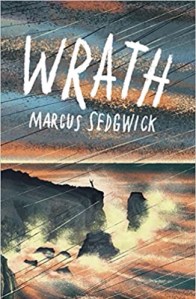
Unfortunately my to read mountain remains exactly as high as it was last week as personal circumstances have prevented any reading this week. I’m hoping things will improve in the coming days and I have some wonderful books to look forward to reading. The Beatrice Prophecy is sitting by my bed so that’s first and Rivals on The Track by Annelise Gray is a book I’ve been looking forward to reading for ages so I have fingers crossed that I will have time to savour that too. Wrath by Marcus Sedgwick is waiting in the wings for when time allows.
Although I haven’t been able to read this week listening has proved to be a comfort instead and I can recommend this lovely episode of Word of Mouth with Michael Rosen and Dr Kathryn Mannix. It is full of thoughtful, kind, wise advice on how to listen well and how telling our stories helps us. It gave me a lot to think about.
Articles, news and resources…
Books for Keeps Latest Issue – I always look forward to this online publication packed full of interest for children’s book lovers. Beyond the Secret Garden investigates abridgements made when books are revised for younger readers and The Must Reads of 2022 include Phil Earle’s follow up to When the Sky Falls and the long awaited Tyger by SF Said.
Empowering & Inclusive Books for your Kids: Online event – in addition to the Life Changing Libraries event that I shared in last week’s Reading Matters Herne Hill Kids Lit Festival are also hosting this online discussion with an expert panel: Jeffrey Boakye, A.M.Dassu, Steve Antony, Alexandra Strick and Zoey Dixon. It takes place on Friday 4th February 7.00pm – 9.00pm. More details and registration via the link.
A good book ushers in the winter of wellbeing in public libraries – public libraries are joining Wales’ Winter of Wellbeing initiative by launching a campaign to promote the proven difference reading can make to young people’s lives and the power of public libraries to support them. You can find out more about this in this article on the Welsh Libraries website link above.
Sign up for the National Reading Champions Quiz 2022 – The NRCQ, provides an opportunity for students aged 10 – 14 to enjoy a book quiz with their peers and compete with other schools in their region. The heats will run online throughout March with the winning teams from 20 regions going forward to a star-studded, national final on 25 May in London where one team will be crowned National Reading Champions 2022. Full details and how to register via the link.
Carnegie and Greenaway Shadowing 2022 – a reminder that if you would like to join this year’s Shadowing Scheme the long lists are announced in March and it would be a shame to miss out. Registration for the publicity packs closes on 4th February.
Portable Magic Dispenser, Vol. 4 Issue 5 – if you are a school librarian and haven’t already signed up to Lucas Maxwell’s regular newsletter I would definitely recommend it. This issue includes reading for pleasure ideas, online learning and podcasts for sixth formers.
CLPE named London Book Fair Charity of the Year 2022 – Each year, The London Book Fair launch their Charity of the Year initiative, inviting book, reading and literary-related non-profit organisations to apply. The Centre for Literacy in Primary Education has been recognised for the excellent work this charity does for all aspects of children’s literacy.
Reading for Pleasure: Supporting Secondary School Students – article by children’s author and former teacher Lucy Strange for the Open University Reading for Pleasure website providing tips and advice. She also highlights the work done by publishers Barrington Stoke in this area. Hurrah for Barrington Stoke!
CILIP School Libraries Group: Why Should I Develop My Skills – article by Barbara Band for SLG Connect containing helpful advice for school librarians. Barbara highlights the CPD opportunities available for school librarians and the reasons why maintaining and improving knowledge and understanding of developments is important both for the librarians and the schools they serve.
Coming soon! The Read for Empathy Collection – the new book collection for this year’s Empathy Day launches on 26 January 2022. Watch the expert judges reflect on the selection process and why this collection feels so important right now in the video available via the link above.
Finally, some book reviews that caught my eye this week…
The Boy Whose Wishes Came True by Helen Rutter – the title suggests magic and fairy tale to me but as I read Andrew Rough’s thoughtful review I realised that this book is about important things such as trust, empathy, hope and confidence. Thank you Andrew, I want to read this now and I think others will do too.
Viking Boy: The Real Story by Tony Bradman – A non-fiction guide to the Viking world, told by the hero of Tony Bradman’s bestselling novel Viking Boy. Nicki Cleveland says “This would make a fantastic read for pleasure for anyone who loves finding out about different cultures in history, with the gruesome bits left in, and would be a perfect addition to any Key Stage 2 Vikings topic box.”
Monstrous Devices by Damien Love – I had missed this book published last year but it is now one I would like to read thanks to Paul Watson’s cracking review. Paul describes it as “a belter of a book” so you may want to find out more and read his review too.
That’s everything for this week and I do hope that something here will be helpful to you. Happy reading!
Eloquent and insightful, the English adaptation of the award winning Welsh novel The Blue Book of Nebo by Manon Steffan Ros is a memorable read. As I turned the last page of this deeply affecting story I wanted to go back to the beginning and start again.
Set in the year 2026 this post nuclear apocalypse novel is told in a dual narrative by fourteen year old Dylan and his mother Rowenna. Together with Dylan’s baby sister, Mona, they are surviving alone in the isolated village of Nebo in north-west Wales. Six years previously their lives were changed irrevocably by The End, when the electricity went off for good following a catastrophe during a nuclear war. Mother and son record their thoughts, both of life before and their struggles for survival, in a notebook they find which Dylan names The Blue Book of Nebo. Rowenna and Dylan share a close and loving relationship but through their journal entries the reader learns both the secrets they keep from each other and their fears, hopes and hidden emotions.
It is fascinating to watch how both mother and son develop. Dylan matures, becoming capable, taking on responsibility and protective of both his mum and his baby sister. There is initially a lack of worldly understanding due to his situation and his young age when everything changed and yet through his experiences he discovers a sense of self, fitting in well to this new life and it is in some ways a coming of age for this young man. Dylan has few memories of before The End and it is through Rowenna’s writing that we learn of the panic and the breakdown of normal society. Rowenna was a quiet and reserved young woman and possibly overlooked previously. Her shyness and insecurities were a barrier and limited her in some ways. Now she is a “warrior” preserving what matters most to her. The resilience and determination she displays are impressive and I was moved by her attitude and her admirable fortitude.
This story is at times raw and heartbreaking and at others tender and hopeful. Although Rowenna and Dylan face loss, privation and hardship, this is balanced with a shared love and understanding. Some aspects of their experience resonate with the reader even more due to the book’s timely nature as we face the ongoing effects of the Covid pandemic. Key to the story is an exploration of our understanding of what matters most. There are many layers to this story and to the ideas and themes it conveys. It portrays the importance of our shared humanity and the balance between what we actually need and what we want or indeed expect from life. When everything is stripped away and survival is highlighted people may discover previously unknown strengths. Both Rowenna and Dylan display resilience and an appreciation of the natural world and their place in it.
The importance of books, faith, spirituality and the value of preserving the Welsh language run through the heart of this profoundly affecting story and I now want to learn more about some of the Welsh books mentioned. This fascinating interview with the author has helped me and you may find it of interest too.
Manon Steffan Ros had created a remarkable story which encourages thought, discussion and further reading. Although a novella aimed at the YA audience this is an excellent read for adults of all ages; great for book clubs I think. Published by Firefly Press on 6th January and highly recommended. Thank you very much to the publishers for my proof copy.
Welcome to this week’s round up of what has been happening in the world of children’s books. My usual system of collating news on a daily basis fell victim to unforeseen events this week I’m afraid so this is posted today with fingers crossed that I have not missed something vitally important. I do hope that you find this week’s collection helpful.
What I’m reading…
Regular readers of the blog will know that I am a fan of the publishers Barrington Stoke who aim to produce super readable books that enable all children and young people to experience the joy of reading. The classics can be daunting for many as the language, the complexity and the length may be a struggle to overcome. Laura Wood’s accessible adaptation of Pride and Prejudice for Barrington Stoke will ensure that this classic story reaches a new audience.
At the beginning of the week I read the much acclaimed The Blue Book of Nebo by Manon Steffan Ros. Everyone raving about this remarkable story was right, it is an affecting and memorable read which although undeniably poignant and even raw at times manages to convey positivity and the depth of love too. Unfortunately my review has not yet been written due to my disrupted week but I’m hoping to post it in the next couple of days.
News, articles and resources…
Make a Miniature Book with Axel Scheffler – join Seven Stories for a very special school event with author and illustrator Axel Scheffler hosted in partnership with the British Library. Wednesday 19th January 2022, 11am Recommended age: Y3, Y4, Y5 & Y6 . Registration is FREE and open to schools anywhere. This sounds lovely and more details are available via the link.
OU Reading for Pleasure: Developing Informal Book Chat with Jon Biddle – In this 2-minute video, Jon Biddle explains how his school encourages informal booktalk. He highlights the need for initial scaffolding and teacher modelling as well as strategies that help to trigger more spontaneous child-led book blether reader to reader.
Which Books Do You Use in Your Year 1 Classroom? – Please can you support this research by Matthew Courtney @mattheweduk exploring representations of ethnic minority groups, LGBTQ+ identities & characters with disabilities in the books used in Year 1 classes. Sharing with other educators will help provide a fuller picture which will add value and make this research useful in the future. For more information and to complete a very quick survey please see the link above.
Literacy Year – thank you to OU Reading for Pleasure for sharing this in their newsletter. Literacy Hive have produced a free online calendar of events, awards, festivals and competitions to help with your literacy planning and encouraging reading for pleasure.
Pulling a White Rabbit Out of a Hat: Interview with Zaro Weil – When Poems Fall From the Sky is one of my favourite recent poetry books for children and this interesting interview on the Reading Realm provides an insight in to Zaro’s creative process.
When Hitler Stole Pink Rabbit Holocaust Memorial Day Event with Michael Morpurgo – another event from Seven Stories The National Centre for Children’s Books. Thursday 27th January 2022, 11am Recommended age: Y5, Y6, Y7, Y8 and Y9. An opportunity to hear Michael Morpurgo talk about the book and his friendship with Judith Kerr. You will also be able to see childhood drawings and notes from the Seven Stories archive and hear extracts from the book.
Sophia Duleep Singh: Princess and suffragette inspires children’s book – Sufiya Ahmed’s new book, My Story: Princess Sophia Duleep Singh, for nine to 13-year-olds, has been launched at Ancient House museum in Thetford, Norfolk, which was founded by Sophia’s brother, Frederick Duleep Singh, in 1921. Only last year I discovered this remarkable woman thanks to Bali Rai’s book The Royal Rebel and now want to read this new look at her life.
What To Do When a Teen Tells You They Hate Reading – an excellent and helpful article for Book Riot by school librarian Lucas Maxwell containing useful ideas to persuade teens who think reading is “boring”.
National Literacy Trust Holocaust Memorial Day Resources – a reminder of these free resources for schools. A live event on Monday 24th January with author Tom Palmer and a Holocaust survivor has been added to these and it is necessary to register for this. Full details and links to the additional resources are available via the link above.
Authorfy Author of the Week Videos – in case you have missed this great free resource, each week a different author is highlighted and a video and downloadable book extract is available on the website. This is a good way to introduce your students to new authors and books.
National Storytelling Week 2022 – this annual celebration of storytelling takes place 29th January – 5th February and is a chance to promote and encourage storytelling in your classroom. You can find out more about three event via the official website, link above. You may also be interested in the teaching resources available on the BBC website here.
Life-Changing Libraries: How to develop a Reading for Pleasure culture – online event supported by Arts Council England for primary teachers, literacy leads, school librarians and parents. Emily Drabble and Catherine Millar will be talking about their work with Cressida Cowell on her ‘Life-Changing Libraries’ campaign. Thursday 3rd February 19:30 – 21:00 and you can register via the link
Finally, some book reviews that caught my eye this week…
Kew Lift and Look Birds by Tracy Cottingham – published just in time for the Big Garden Bird Watch at the end of this month this board book sounds perfect for encouraging very young children to enjoy the birds in their local area. Andrea Reece highlights both its interactive appeal and the fact it is full of information in her review for LoveReading4Kids .
Harley Hitch and the Missing Moon by Vashti Hardy – illustrated young fiction is brilliant for encouraging reading for pleasure and this second book in a series by award winning author Vashti Hardy sounds like an excellent example of the genre. As Erin Hamilton says in her review: “this series goes from strength to strength.”
Raven Winter by Susanna Bailey – any review that says “Perfect for fans of Gill Lewis, Susanna’s books unpick challenging issues, whilst celebrating the great outdoors and the healing power of nature.” is guaranteed to pique my interest. I have not read any books by this author yet but Emma Kuyateh’s positive review has persuaded me to add this title to my wish list.
That’s everything for this week and I hope to be able to catch up with anything I have missed, particularly book reviews, and share it with you next Saturday. Happy reading!
The publishers Barrington Stoke aim to produce super readable books that enable all children and young people to experience the joy of reading. The classics can be daunting for many as the language, the complexity and the length may be a struggle to overcome. The story of Elizabeth Bennett and Darcy contains themes that would appeal to teen readers and Laura Wood’s accessible adaptation will ensure that this classic story reaches a new audience.
Cover artwork by Helen Crawford-White
When rich and handsome Mr Bingley moves into the local area Mrs Bennett, mother to five daughters, cannot contain her excitement. She plots and plans, cajoling her husband into making invitations. Elizabeth, the second eldest daughter, and a spirited, witty and intelligent young woman has no wish to make a marriage of convenience. While her older sister Jane develops an attraction for Mr Bingley, Lizzie finds his equally wealthy and handsome friend Mr. Darcy aloof, proud and selfish. She sets her face against any prospect of marrying such an unagreeable man. However in a confined society their paths are destined to cross again and again and perhaps the first impressions of both may have been mistaken.
Condensing this beloved story into an abridged form told in contemporary language must have been a daunting task but Laura Wood has managed to retain the lightness that helped to make the original so popular. Inevitably some parts of the story have to be left out and the author fills in the gaps with care so that the main storyline and the relationships between the characters are conveyed to today’s young readers. Elizabeth’s spark and stubbornness is still there and Mr Darcey, although a little more sympathetic than I remember him initially, retains that aloof dignity. The story itself is told in short chapters and in a concise form but still has that recognisable appeal.
This would be an excellent book for secondary school libraries and classrooms providing an accessible version for dyslexic readers or children for whom English is not their first language. Its engaging style may also encourage reluctant or nervous readers to try the original version. It would be a valuable reference or quick reminder of the basic plot too. As with all Barrington Stoke books this is produced in a dyslexia friendly format and has been edited to a reading age of 9+ but with a teen readership in mind.
Pride and Prejudice: a retelling by Laura Wood was published on 6th January and I would like to thank the publishers for providing my review copy. Barrington Stoke have published other abridged adaptations of classic books and I would recommend Jane Eyre and Wuthering Heights both by Tanya Landman.
Barrington Stoke have made the first chapter of this book available to provide a taste:
Welcome to the first Reading Matters newsletter of 2022 and I hope that everyone had a happy and healthy Christmas holiday. This week’s round up includes both a look back at the best of 2021 and a preview of some books we can look forward to at the start of this new year. There are events and resources too so why not settle down and explore.
What I’m reading…
Before we get stuck into a new year of reading I did have a look back at some of the wonderful books that I enjoyed most last year. You can find out more about them in 2021 – A Year in Children’s Books. One beautiful illustrated book stood out for me last year and I do think that Once Upon A Tune: Stories from the Orchestra by James Mayhew deserves a place in every primary school as it is both inspirational and enjoyable.
Over the Christmas break I caught up with some books that I had been intending to read for ages. Untwisted: the story of my writing life by Paul Jennings was a fascinating read and contains excellent advice for would be writers and also for educators trying to instil a love of reading and writing in their pupils. Keeper of Secrets by Sarah J Dodd is a beautiful and sensitive story exploring our relationship with wild animals and how nature can sometimes help to heal grief. A debut published in September 2021 with teaching resources available on the publishers’ website I think this would be excellent for upper primary children.
This week I have read Yusuf Azeem is Not a Hero by Saadia Faruqi. Published to coincide with the commemoration of the twentieth anniversary of the 9/11 terrorist attacks, this is a powerful and important book. Excellent for KS3 and YR6 this book demonstrates the value of writing about recent historical events for young people to aid their understanding.
All of these books plus those included in the reviews section below can be purchased online via Bookshop.org
The highlight of my week was definitely Nikki Gamble’s Audience With Kate DiCamillo. One of my favourite authors she has a knack of conveying emotion and humanity in a few well chosen words. Listening to her was wonderful and I gave up writing down all the quotable things she said as it all resonated with me, and with everyone else attending I think. I will highlight one particular phrase which I recognised personally and maybe you will too, ‘I feel most like myself when I’m reading.’ Thank you to Nikki for making this special evening possible.
News, articles and resources…
BooksForTopics Books of the Year 2021 – the community of primary teachers, TAs, librarians, authors and children’s book lovers were asked to vote for their favourite children’s books published in 2021 and the winners were announced last week. There are several categories and this is a fabulous selection for the primary age group.
Discover CLPE staff’s favourite reads in 2021 – another wonderful range of books selected by the experts at the Centre for Literacy for Primary Education. The list is free to download and includes helpful summaries of the titles too.
Costa Book Award Winners Announced – on 4th January the winners of the the different categories were announced and Crossings by Manjeet Mann is The Costa Children’s Book Award 2021 Winner. I have read several excellent reviews of this verse novel and hope to read it soon. You can find out who won the other categories and view the shortlists via the link above.
Tom Palmer’s Holocaust Day Memorial Day Resources – Holocaust Memorial Day takes place on 27th January and award winning author Tom Palmer has collaborated with the Literacy Trust to produce a range of free resources including videos and worksheets etc. The resources are designed to be used throughout the week beginning Monday 24 January 2022, and are suitable for use with students aged 9 to 14 (Upper Key Stage 2 and Key Stage 3). More information is available via the link above.
Narniathon21: A Jovial Comedy – I have thoroughly enjoyed reading and participating in the series of posts discussing The Lion, the Witch and the Wardrobe over the last week or so as part of this initiative organised by Chris Lovegrove. The link above takes you to Chris’s review and summary of this first book in the Narnia series. If you are interested in finding out more I would also recommend this post #Narniathon21: Through the door and the discussion in the comments which is fascinating. January sees the reading and discussion of Prince Caspian.
New research Girls: The Reluctant Girl Readers – the National Literacy Trust in partnership with Estée Lauder have produced a report on an aspect of reading that does not always receive attention. Data from their 2021 Annual Literacy Survey, in which 21,696 girls aged 8 to 18 from across the UK participated, indicates that more than 2 in 5 (44.1%) of them don’t enjoy reading. For more background and fuller details please use the link above.
January Book Blast with Nikki Gamble – on Monday 10th January at 7pm catch up with the children’s books out in January with Nikki Gamble and there is the chance to win some lovely books too. Registration is free via the link above.
Book Trust: New Children’s Books We Love – every month, the Book Trust team review dozens of books for children and teenagers. Here are the ones they like best in January divided into age group categories.
The Most Popular Manga for High School Students – school librarian Lucas Maxwell’s article for Book Riot highlights the titles that are most popular with his students from age 11 or 12 right up to 18.
Mr Dilly Meets – Christopher Lloyd and Jenny Pearson – a date for your diary. On Wednesday, January 19th 11:00 AM – 12:00 PM a free event for schools. If you are unable to watch live, the event will also be available to view directly afterwards on the MR DILLY YOU TUBE channel. You can find our more about the event and register via the link above.
Jericho Prize Finalists Announced – The Jericho Prize is a new prize for unpublished and self-published Black-British writers. The five finalists in two categories, picture book (4+) and short chapter book (7-9) are Cabbi Charles, Diane Ewen, Seymour Lavine, Ellah Dinnall and Abimbola Salami. The 2021 award winners will be announced on 27 January 2022. You can meet the finalists in the video via the link.
An Evening with Anne Fine – Nikki Gamble, David Fickling and Old Barn Books invite you to an Evening with Anne Fine on 1st February at 7pm. Anne has two new novels publishing in February: Shades of Scarlet, published by David Fickling Books and Aftershocks published by Old Barn Books. The webinar is free and you can register via the link.
Finally, some book reviews that caught my eye this week…
The Queen in the Cave by Julia Sarda – Mélanie McGilloway reviews this picture book and hosts an interview with its creator in this fascinating blogpost. Published in October 2021 I had missed this book but the peep provided looks stunning and it is so interesting to learn about the story behind the art.
Meg and Merlin: Making Friends by Tanya Landman & Sonia Albert – the latest title by Tanya Landman for Barrington Stoke was published this week. In my experience ‘pony books’ are popular in school libraries and Kate Heap says in her review: “This lovely story is perfect for horse lovers and anyone who has a dream.’’ One for school librarians’ to buy lists!
The Secret of the Treasure Keepers by A.M. Howell – regular readers of the blog will know that I have a soft spot for historical fiction and I very much like the sound of this. Veronica Price says, “You rapidly lose yourself in the mystery, making it very difficult to put the book down or cease to think about the characters and their plight even when you have to break away and return to everyday reality!” This author’s previous books have been immensely popular with teachers in the classroom and this sounds like another winner.
The Sad Ghost Club Volume 1 by Lize Meddings – there has been chat online about the popularity of this graphic novel in secondary school libraries so this review caught my attention. The first book was published in December with the second due out this month. The Sad Ghost Club community has over half a million followers on instragram so it clearly has that special something. I’m tempted to get hold of a copy now. The LoveReading4Kids review linked above tells you more.
That’s everything for this week and I hope you have found something among the links of interest or helpful. My reading weekend is starting with Laura Wood’s adaptation of Pride and Prejudice for Barrington Stoke. I hope you have a happy weekend with some time for reading. A reminder that all the books featured in this newsletter can be bought on the Bookshop.org website. Happy reading!
Disclosure: If you buy books linked to our site, we may earn a commission from Bookshop.org, whose fees support independent bookshops.
Yusuf Azeem is Not a Hero by Saadia Faruqi was published to coincide with the commemoration of the twentieth anniversary of the 9/11 terrorist attacks and is a powerful and important book at any time. Despite the subject matter of discrimination and prejudice this is a story of hope and understanding.
Twelve year old Yusuf is starting middle school and although a little nervous he is looking forward to new adventures and most especially to competing in the regional robotics competition. On his first day he discovers a note in his new locker bearing a cruel message and his joyful anticipation dwindles.
Yusuf’s family are Pakistani Americans, his father owns the local store, his mother works from home and Yusuf is close to his little sister. They are part of a friendly Muslim community who are working together to build a new mosque just outside the town of Frey where the family live. Yusuf does not confide in his parents about the notes which appear almost daily in his locker, nor does he tell his best friend Danial. However as the anniversary of the 9/11 terrorist attacks draws near the forthcoming commemorative parade prompts a hostile group of townspeople to protest against the mosque. Yusuf is also finding himself up against a bully at school whose father is leading the protest. As the Muslim community becomes more nervous Yusuf’s school life, his friendships and his family life struggle in the face of prejudice and discrimination.
Saadia Faruqi deftly conveys this story across two time periods with the inclusion of Yusuf’s Uncle Rahman’s journal which he has passed on to the boy. The interweaving of the events of 2001 and the present day captures the trauma of the attacks on the American people and the lasting impact they have had on the communities affected. Although the subject matter is distressing Faruqi has an understanding of her readers and descriptions are not graphic but they do convey the emotions felt by the people involved. As an inter -faith activist the author concentrates on the power of communication and understanding to breach the divide between people and this is a hopeful and positive read.
The everyday school life, the boys’ friendships and family life are full of the little details that children will recognise and enjoy reading. There are some interesting characters in Yusuf’s life, both adults and children. His teacher, Mr Parker, is full of enthusiasm and kindness, and school boy Jared deserves a story of his own. The dynamics of the friendships as they are tested and reconciled are well written and young readers will, I think, engage with these character and the moments of humour. Yusuf himself is a wonderful blend of shy, quiet and maybe a bit of a nerd, but on the other hand loyal, principled and determined, learning to stand up for what he believes and for what is right.
Yusuf Azeem is Not a Hero is a powerful story with an important message. As Yusuf’s Uncle Rahman says, “History informs the present , …and so it affects the future.” This book would be excellent for KS3 and YR6 and demonstrates the value of writing about recent historical events for young people to aid their understanding. There are teaching notes available on Saadia Faruqi’s website.
I should like to thank the publishers, Quill Tree Books, for my proof copy. Yusuf Azeem is Not a Hero was published in October 2021. You may be interested in A Thousand Questions also written by Saadia Faruqi which is set in modern day Karachi, and is told from the perspectives of two eleven year old girls.