
The nominations have been announced for two prestigious literary awards. The CILIP Carnegie Medal is awarded for an outstanding book written for children and young people and the CILIP Kate Greenaway Medal is awarded for distinguished illustration. This year, 254 books have been nominated for the 2019 Medals; 137 books for the CILIP Carnegie Medal and 117 for the Kate Greenaway Medal. This year, in addition to CILIP members, those able to nominate included bodies such as, BookTrust, CLPE, Commonword, IBBY, Inclusive Minds, National Literacy Trust and RNIB.
Following controversy last year over the lack of BAME authors on the long lists a review was carried out by CILIP and an action plan implemented which included enhanced diversity training for the judges and an equality, diversity and inclusion advisory panel to support and advise on the Awards process. Initial reactions to the nominations would suggest, I think, that some progress has been made regarding this and there are also titles that are English translations.
The Carnegie Nominations
Each year I find that I have read more of the Greenaway list than the Carnegie. As a primary school librarian I have always tended to concentrate on picture books, younger and middle grade fiction and out of habit and sometimes preference that is what I continue to do. Therefore my assessment of the nomination lists will reflect that. It is wonderful to see such a wide range of titles nominated for the Carnegie this year and there are several that I have read and enjoyed very much. There are also many that I am now determined to move up my enormous reading pile to find out why they are highly regarded by others.
The full list can be viewed on the official website. Here is just a quick taste of some of my favourite books, not based on any judging criteria, but on my own enjoyment.
Moonrise by Sarah Crossan
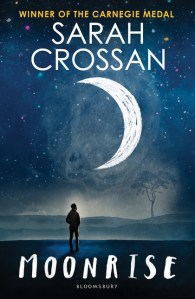
Having said that I concentrate on middle grade fiction Sarah Crossan is a YA author that I always make an exception for. For me, she makes poetry accessible for all and her wonderful books always have an impact on the reader. I simply could not stop reading this until I finished it and read the book in one sitting. It is a remarkable, important and deeply affecting story. If you read it I have a feeling you will never forget it. The story is a poignant examination of the death penalty and leaves the reader deeply affected by the loss and trauma experienced by the two brothers, Ed and Joe, around whom the story centres. If I was a betting type I would put money on Moonrise making it to the shortlist.
The Infinite Lives of Maisie Day by Christopher Edge
 I love it when a book surprises me and this definitely did. This is a different but very satisfying read. The world of science combines with the unbreakable bonds of true family love in a well written story. The parallel timelines work brilliantly in my opinion and the reader is left guessing right until the end. Link to my review and teaching resources here.
The Goose Road by Rowena House

Historical fiction set in France during World War 1 this debut is beautifully told and provides a window on the lives of civilians living there at the time and how the war affected them. I first met Angelique in the author’s short story for The War Girls collection and loved and admired her persistence in that and again in this novel. The book tells the story of her epic journey across France in a desperate attempt to save the family farm for her brother who is fighting at the front. Despite the sadness this is definitely a story of hope. It would be a great WW1 read for KS3 & mature YR6 readers too.
Sky Song by Abi Elphinstone
 I am delighted to see this book on the list. Having followed Abi’s progress from the early days of a proof copy of The Dream Snatcher I have seen the way in which her stories touch children. Sky Song typifies why children’s books matter. Courage, kindness, acceptance & hope are wrapped up in a thrilling adventure. My favourite of all this author’s books so far. You can read my full review here.
Kick by Mitch Johnson
 When I read this earlier this year I thought that it was an extremely impressive debut. It has at its heart a lead character with whom readers will readily engage. An important story told in an accessible way, endorsed by Amnesty International and is highly recommended for Yr6+.
As a lover of historical fiction for all ages I am so pleased to see Emma Carroll featured on the list. Not once but twice!
The Secret of the Sun King
 This is an exciting adventure with heart bringing history to life for young readers. The two linked stories, one in 1920s London and the other in ancient Egypt, have themes that weave the two together in a satisfying whole. Friendship, secrets and efforts to correct past mistakes are part of an absorbing and well plotted adventure that moves at a pace sure to keep readers engrossed until the very last page. Here is a link to my review and some teaching resources.
Sky Chasers

I loved Sky Chasers. It is fabulous fiction for children aged 8+ and is full of intrigue, thrills, bravery and loyalty. Set in 18th century France this is a period not often covered in fiction for this age group. Historical events are made to feel fresh and relevant for today’s readers. You can find out more by reading my review.
There are many other wonderful titles that have been nominated and it is great to see a mix of established authors, previous winners and debuts from new voices too.
Among the many books that I hope to read before the long list is announced in February are Worry Angels by Sita Brahmachari and Jane Ray, Jelly by Jo Cotterill, Bone Talk by Candy Gourlay, The Muslims by Zanib Mian and The Boy at the Back of the Class by Onjali Q. Rauf.
The judges have a staggering task with so many books to read before a long list can be produced. A huge thank you to them all for their time and commitment.
 needs no introduction such has been its impact. Nominated for both the Greenaway and the Carnegie awards this is truly a collaboration. A gloriously illustrated work of art, a collection of magic spells and most definitely a book to treasure this is a book for all ages and for all types. The Lost Words brings together poetic literature, fine art and a fascination with nature. Most importantly this is a book to share so that its message can grow, spread and work as its creators hope it will. I have written more about the background to this book
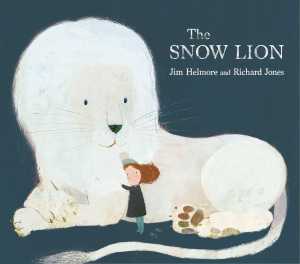 Caro and her mother arrive at their new home in darkness. Once inside, the house is white, bare and empty. Caro wishes that she has someone to play with and feels a little lost and small. Then one day she hears a noise and a gentle voice asking to play. She has a new friend and a very special one. The Snow Lion has appeared as if by magic to help Caro learn how to make friends of her own and maybe find the courage she has been hiding inside.
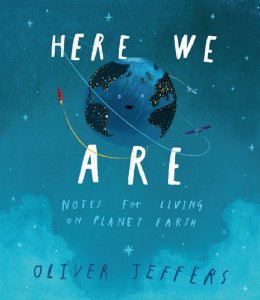 A tender guide written to his newborn son to help him make sense of the world around him. This lovely book is also a short but thoughtful essay on what makes our global community work and would be treasured by older children and adults too. Gorgeous illustrations full of detail and double pages that you want to linger over and examine. It would be brilliant to use in primary school classrooms. My full review and links are





 Madeline Finn does NOT like to read. But she DOES want a gold star from her teacher. But, stars are for good readers. Stars are for understanding words, and for saying them out loud.
  When Bear reluctantly agrees to go with his friend, Mouse, to the big library, neither rocket ships nor wooden canoes are enough for Bear’s picky tastes. How will Mouse ever find the perfect book for Bear?
 When we are fast asleep in bed, the Midnight Library opens its doors to all the night-time animals. Inside the library the little librarian and her three assistant owls help each and every animal to find the perfect book. But with a noisy squirrel band, an upset wolf and a slow-reading tortoise to help, they could all be in for a very busy night.
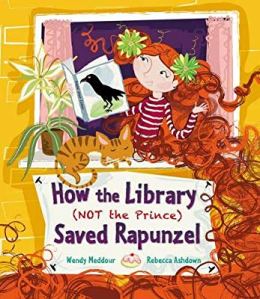 Rapunzel sits on the sixteenth floor of an inner city block, bored, dreaming and looking out at the rain. No one can rouse her from her apathy, not the milkman or the postman or the baker or her aunt – or even the prince. But when at last a letter is delivered, it contains news that has Rapunzel on her feet again. She has a new job at the library! And suddenly her life is busy, sparkling, exciting and stimulating.
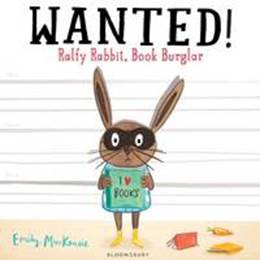 Some rabbits dream about lettuces and carrots, others dream of flowering meadows and juicy dandelions, but Ralfy dreams only of books. In fact, he doesn’t just dream about them, he wants to read them ALL THE TIME. Soon his obsession sends him spiralling into a life of crime!


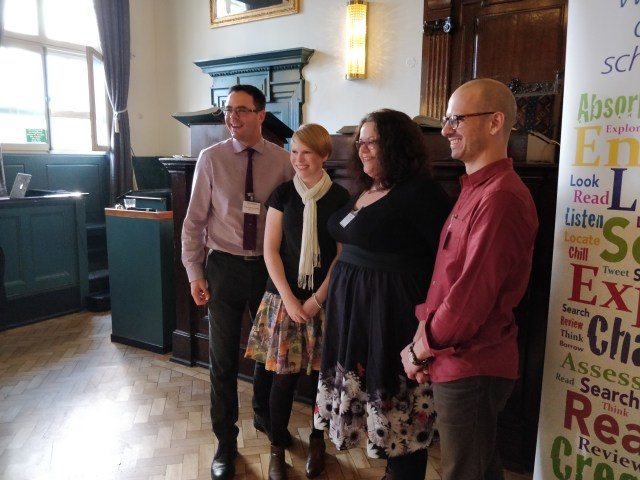
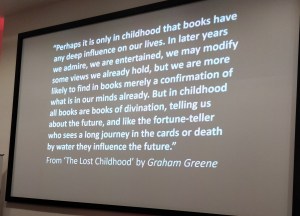 Christopher Edge, award winning children’s author and former teacher made this remark during his keynote speech in the afternoon and this was, I felt, the key to the whole day and the reason we were all there. He expanded on this by sharing a quote from The Lost Childhood by Graham Greene and shown on the slide here. He went on to say that books open doors to other worlds for children and by opening many doors we help children’s understanding, provide them with a refuge and perhaps the possibility that they will in turn create a better world. This importance highlights the need for access to a wide range of books for all children through libraries and schools. It was fascinating to hear how Christopher was influenced by Neil Gaiman’s work as a child, sneaking off school to get a book signed by the famous author at a local bookshop. Discovering that authors were in fact ”real people” inspired him to go on to become an author himself. One very good reason to encourage author visits to schools for as Christopher himself said ”Scratch every writer and you find a reader.”
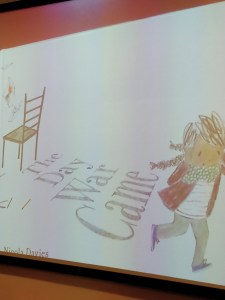 Nicola Davies says that when she writes books such as Lots (illustrated by Emily Sutton) she wants children to say when they reach the end, ”Wow! I want to know more about that.” Although some may say that war is not a suitable topic for young children she maintains that children are exposed to difficult subjects via the media on a daily basis and therefore it is our duty to talk about the world with all its beauties and horrors with them. In her stunning book, The Day War Came (illustrated by Rebecca Cobb) war and its impact on refugees is dealt with in an extremely moving yet age appropriate fashion. During the Q & A Panel in the afternoon Jane Considine mentioned this subject again, remarking that it is our moral duty to ensure that children learn about lives and worlds different to their own.


 Library Lady