Today, 1st October, National Poetry Day, the Centre for Literacy in Primary Education(CLPE) announced the 2020 shortlist for the CLiPPA (Centre for Literacy in Primary Poetry Award). Established in 2003, the CLiPPA is the UK’s only award for published poetry for children. There has been a renewed focus on the value of poetry this year with many more people, including children, accessing verse online possibly as a source of comfort and encouragement. I know I have read more poetry than I usually do. The 2020 shortlist reflects the extraordinary vitality of the UK’s poetry publishing for children.
The full shortlist is:
Midnight Feasts. Tasty Poems chosen by A.F. Harrold, illustrated by Katy Riddell, Bloomsbury. The judges said: a delicious and quirky collection of poems old and new, skilfully curated and perfectly paced.
Poems the Wind Blew In, Karmelo C. Iribarren, illustrated by Riya Chowdhury, translated from Spanish by Lawrence Schimel, The Emma Press. The judges said: a book to carry around with you, proof that poetry is ideas, thoughts and emotions captured in words.
The Proper Way to Meet a Hedgehog and Other How-To Poems, compiled by Paul B. Janeczko, illustrated by Richard Jones, Walker Books. The judges said: a wonderfully varied collection of poems that will speak directly to young children, full of beautiful examples of the craft of poetry
Wain. LGBT Reimaginings of Scottish Folklore, Rachel Plummer, illustrated by Helene Boppert, The Emma Press. The judges said: a fresh voice and take on something that could have felt archaic but is made to feel new.
Cherry Moon, Zaro Weil, illustrated by Junli Song, ZaZaKids Books/ Troika Books. The judges said: meditative and nicely paced; Weil presents beautiful snapshots of the natural world and has thought carefully about the form for each.
The shortlisted titles
Steven Camden, poet, winner of the 2019 CLiPPA commented: “I was pretty nervous going into the judging meeting because I felt really strongly about my choices. My favourites on the list really affected me and I was apprehensive about fighting their corner with people I didn’t really know. Within five minutes it was clear that those books that touched me had touched the other judges just as strongly and what followed was a gorgeous celebratory conversation of some truly stunning creations. What a treat and privilege.”
In a first for the CLiPPA, thanks to a new partnership with The Times and The Sunday Times Cheltenham Literature Festival, the winner of the 2020 Award will be revealed at the culmination of the festival’s schools’ programme, on Friday 9th October in a Poetry Show introduced by CLiPPA judges, poets Valerie Bloom and Steven Camden, and featuring performances by the shortlisted poets as well as live drawing by former Children’s Laureate Chris Riddell.
Schools across the UK and beyond will be able to watch the show for free on The Times and The Sunday Times Cheltenham Literature Festival platform and access poetry CPD sessions created by CLPE. The free Shadowing Scheme to involve schools in CLiPPA2020 will launch alongside the announcement of the winner. It is wonderful news that registrations for the scheme are set to be twice what they were in 2019 as 350 schools had enquired about the scheme even before it opened. If you are interested you can find out more about the CLiPPA shadowing scheme on the CLPE website.
Vashti Hardy’s first title for Barrington Stoke contains all the components required of the perfect adventure story for children. A brave if somewhat impetuous lead character, clues to solve, villains to defeat, a wise and loyal companion and a map. Oh, and the ability to teleport! The steampunk fantasy style that this award winning author has become known for is presented here in a shorter but equally exciting version. This will introduce even the most reluctant of readers to a whole new world of adventures with further stories to follow in the series.
Grace’s family are wardens of the Griffin map, the most important piece of technology in the city of Copperport, and have been since the days of Great Grandma Griffin. They use the map to protect the whole country of Moreland and keep law and order throughout the land. The portals on the map allow them to travel to wherever help is needed and once there they right wrongs with the help of technology and skill. However Grace is still training for the role and when her Mum and older brother, Bren disappear on their missions she is left behind. Grace longs to join them and one day she seizes the opportunity to show them that she is capable of being a fully fledged warden too. However her ensuing adventure is not as straightforward as she had hoped.
This has the feel of a big adventure despite being told in fewer than one hundred pages. A great plot, characters who develop throughout the story and a realistic fantasy world are all created by Vashti Hardy. The importance of family and the use of power for good is incorporated into an irresistible adventure with care. Grace is a brilliant character, I warmed to her and think readers will do so. The illustrations by Natalie Smillie throughout the book add to the enjoyment and complement the text well capturing the essence of the characters and the storyline.
This is a book combining fantasy and technology with friendship and family in a world created by an author who understands what appeals to young readers. We have episode two, The Puffin Portal, to look forward to in 2021 as well.
As with all books published by Barrington Stoke Unique The Griffin Gate is produced in a dyslexia-friendly font specially created to make reading easier and an accessible layout and heavier paper with a gentle tint helps reduce visual stress. Careful editing ensures that this story can be enjoyed by children with a reading age of 8+.
I should like to thank Kirstin Lamb and Barrington Stoke for sending my review copy. The Griffin Gate is published on 1st October and will be available in all good bookshops and online at independent bookshop Bear Hunt Books.
Inspired by the true story of Sudan, the last male Northern White Rhino, this powerful picture book will inspire children to think about global conservation and how we can help preserve endangered animals.
Award winning author Nicola Davies has written over sixty books and many of them have dealt with the world of nature or have made difficult subjects accessible for younger readers. In this, her debut as an illustrator, she combines both. Last is a book for our world today, an important reminder of what we are in danger of losing and a rallying cry to join together to do our part to help. Children care about conservation and Last will, I think, resonate with them.
A rhinoceros remembers his life before captivity in the zoo in which he now paces. Before this world of grey there was colour, familiar sights and smells, and his mother. Then his mother is killed by poachers and the young rhino is transported in a cage to a zoo in an unfamiliar and unwelcoming place. He fears he is the last. But he is not alone, there are other animals in the zoo alongside him. Perhaps they are the last ones too. As he longs for home there is someone watching who cares and who may rescue him and enable him to return to a life of colour and to home.
The text and the illustrations together make the reader aware of the contrast between the life of the rhino before and during captivity. The grey bleakness of the city zoo and the animal’s misery depicted on the cover and the first pages are starkly different to the vibrant pages that follow showing his life in his natural habitat. The illustrations of the city incorporate quotes from advertising and environmental speeches translated into different languages. Nicola Davies says her aim was to ‘contrast the bleakness of advertising with inspirational words.’ The story ends with a feeling of hope for the future and the author’s note at the end of the book provides more information about Sudan and a note of encouragement to the reader on how to help further.
Last would be a valuable and important addition to primary school libraries and classrooms prompting discussion and encouraging children to find out more.
Thank you to the publishers, Tiny Owl Books for providing my review copy. Last was published on 22nd September and is available to purchase at all good bookshops and online
A joyful picture book celebrating how differences enrich our world, this is a story told with a kindly understanding that will reassure and guide young children.
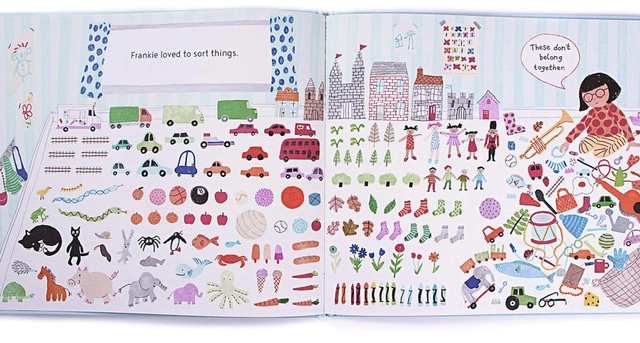
”It takes all sorts” my Mum used to say to me occasionally. She was right, then she often was. However for some people all sorts may mean something subtly different. Frankie loves to sort things, almost everything in her little world is put into categories. She sorts her toys in her bedroom, she sorts everything in the kitchen, she tries to sort flowers, trees and animals. Some things are easier to sort than others and Frankie adopts different systems to classify items, using colour, shape and size to help her. Then she decides to sort people and things become a little trickier. In fact it dawns on Frankie that it may not be possible which is a worry, particularly as she does not know where she fits in.
This is such a lovely package of a book. The story really starts with the cover as little Frankie stands beside a chaotic heap of things, a colourful muddle of familiar objects. On the back cover these objects have now been sorted into neat rows; a procession of vehicles, a line of colouring pencils, a row of stripy socks and so on. The busy endpapers continue this theme with those at the front of the book a glorious, colourful tangle of items recognisable to children. The endpapers at the back of the book depict regimental rows marching across the white space.
Frankie is a competent sorter, methodical in her approach and yet when she comes to look at the people in her world and sorting them her composure slips. Some people clearly belong to each other but with some it is less obvious. As this recognition dawns on the little girl the narrative switches to give her own version of events making her concern more apparent to the reader. Swiftly this concern turns to excitement as Frankie realises that having a world where differences don’t matter and everyone simply lives together in a glorious muddle is absolutely fine.
I particularly like how this book incorporates its message in a subtle and gentle way, just right for the youngest readers. The illustrations by Emily Rand are a total delight; colourful and full of detail they will encourage slow browsing and chat about all those familiar objects. This would reassure the anxious child for whom untidiness or lack of order prompts stress or a child who is struggling to fit in for whatever reason. In addition it would work as an introduction to mathematical concepts; Frankie’s people sorting even involves a Venn diagram!
This is a delightful book with a variety of uses and one that will appeal to the youngest of readers with its cheerful appearance and gentle, comforting themes. Highly recommended for Early Years and KS1.
Thank you to the lovely team at Flying Eye Books for my review copy. All Sorts was published on 1st September and is available to purchase at all good bookshops or online
Hello and welcome to another look at the latest news from the world of children’s books. It’s been another busy week and no doubt I have missed out some delights but I have tried to give an overview of what’s been happening. Yet again I am struck by the generosity of so many providing resources and giving up their time to share ideas and comment. Webinars, podcasts, articles and interviews proliferate at such a rate it is hard to keep up but I very much appreciate all the wonderful work being done by book lovers everywhere.
What I’m reading…
The highlight this week for me was the Reading for Pleasure: The Nectar of Imagination webinar I attended on Tuesday evening, featuring Teresa Cremin, Joseph Coelho, Sonia Thompson and Matthew Courtney chaired by Hayley Butler from The Reading Agency. The description inspirational does not really do the event justice. A key point I took away was that reading for pleasure for children should not be an optional extra but is our social and moral joint responsibility. If you were unable to attend you may watch the recording of the event via these links, Part One and Part Two. I would highly recommend it.
Last weekend I finished reading Moon over Manifest by Clare Vanderpool, her debut and Newbery Medal winner in 2011. A story of relevance today with its dual storyline including the Spanish Flu of 1918 and the creating of community as immigrants from all over the world come together in a shared goal.
I read some wonderful picture books this week, we are being thoroughly spoiled at the moment. The Little War Cat is a beautiful book, a celebration of kindness and hope in the midst of conflict and would be suitable for KS1 upwards. There are more reviews to follow over the next few days.
News and resources…
Reading is Magic Festival – a reminder that this festival starts on Sunday 27th September. Featuring an amazing line up of bestselling authors & illustrators, there are six days of FREE digital events designed especially for schools takes place 27 Sep to 2 Oct. You can find out more and sign up at the link above and there is a list of all the fabulous events here. Events can be watched on the website after the live broadcasts too.
Two books about children fleeing the Spanish Civil War – if you have been following the articles related to World Kid Lit Month you may have seen this but if not it is a welcome exposure of books dealing with historical events that may well be less well known to children in the U.K.
Free National Poetry Day Posters – free posters for National Poetry Day featuring lots of children’s poets considering the question ‘What is poetry?’ available to download on the Reading Realm website. This site is well worth a browse as it contains helpful tips and ideas including poetry starters available here.
Bloomsbury Children’s Poetry Showcase – Join Bloomsbury Education for a special online focus on poetry, with activities, challenges and videos from fantastic poets including AF Harrold, Joshua Seigal, Sarah Crossan and Paul Cookson each day, from 28th September – 2nd October 2020, at 11am and 2pm.
The Promise – a Go Fund Me initiative – a crowd-funder to give copies of The Promise book by Nicola Davies and Laura Carlin to children growing up in nature deprived areas. The organisers will be working with Wild Labs to collaborate with schools and organisations to explore how they can make their communities greener and fairer.
The life of an illustrator: Jim Field – lovely interview with the illustrator of Oi Frog, The Squirrels Who Squabbled and other favourites giving an insight into the inspiration and challenges of life creating the books we love so much.
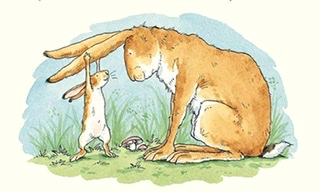
Author Sam McBratney dies aged 77 – probably best known for his best seller, Guess How Much I Love You illustrated by Anita Jeram, beloved of many little ones at bedtime, this is a lovely tribute in the Guardian.
My Library, My Books and Me: Libraries Week Launch Event – I could not resist this and have registered, it sounds great! Annie Everall OBE, Director Authors Aloud UK is joined by Chair of the School Libraries Group, Caroline Roche, plus a fabulous panel of authors, including Carnegie Medal winners Anthony McGowan and Beverley Naidoo, Bali Rai, Jasbinder Bilan, Savita Kalhan, Philip Ardagh and poet Paul Cookson. The panel will kick off the Libraries Week celebrations, sharing stories about the libraries and books that have shaped their world!
David McKee wins BookTrust’s Lifetime Achievement Award – David McKee has won the prestigious BookTrust Lifetime Achievement Award, becoming the seventh creator to do so. David, who has a career that spans over 60 years, is known for creating beloved children’s classics including Elmer, Mr Benn and Not Now, Bernard – stories that are still beloved by young people today. You can read Emily Drabble’s lovely interview with David here.
As children return to school, how can author visits safely return to the classroom too? – Definitely worth reading, this article brings home the importance of author visits to schools for everyone concerned. Children’s author Tom Palmer shares his experience of returning to schools and his top tips for schools and authors who are thinking about arranging a visit this term.
Finally, some book reviews that caught my eye this week…
Honey for you, Honey for Me by Michael Rosen and Chris Riddell – a friend asked for a recommendation for a present for a grandchild this week and luckily I had just read this review. Jill Bennett describes this new book as ”one of the very best gifts you could give a baby or toddler.” Sorted!
Frost by Holly Webb – so many young children when they start out as independent readers are drawn to stories that feature animals that every primary school librarian needs a steady supply of new, quality titles. Veronica Price has found one… “It is such a heart-warming tale of kindness and friendship that I urge you to buy a copy when it is released in paperback format on 1 October.”
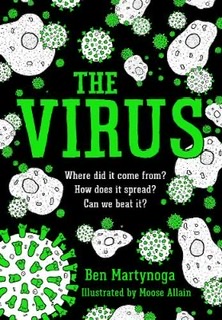
The Virus by Ben Martynoga illustrated by Moose Allain – on the LoveReading4Kids website this is a September Book of the Month. As Andrea Reece explains in her review, this time last year we could never have imagined that we would need a book to provide ‘everythingyou need to know to understand COVID-19’ for children but sadly we do. This book explores the science behind viruses and the COVID-19 pandemic and along the way readers learn what viruses are, how they work, and how we can overcome – or at least learn to live alongside – those that do us harm. Suitable for 9+.
Elsetime by Eve McDonnell – I love time slip novels and this debut caught my attention this week. Book Activist (Victoria Dilley) reviews the book on her website and author Eve McDonnell tells us about the inspiration for her story. This has tempted me even more!
Practical and mathematical books for children – Clare Zirkin reviewed two great book to help explain maths to children on her blog this week. Dosh: How to Earn It, Save It, Spend It, Grow It and Give It by Rashmi Sirdeshpande and In Great Numbers, illustrated by Daniela Olejnikova both of which I would have been grateful for as a child.
That’s all for this week. There is much to look forward to during the coming days including National Poetry Day on Thursday and the announcement of the CLiPPA (Centre for Literacy in Primary Poetry Award) shortlist. Happy reading!
A beautiful story of kindness and hope in the midst of conflict The Little War Cat encourages empathy and understanding and celebrates how each small act of care can make a big difference. A picture book full of compassion.
Cover illustration by Laura Carmichael
We follow the story of a small, grey cat who lives happily in the city of Aleppo and begin with her sunning herself on a wall surrounded by sunshine and watching a butterfly above her head. But as we turn the page we see that everything changed for the people of Aleppo and for the little cat. War came and with war destruction and loss. The small animal wanders the streets looking for refuge, past boarded up shops, searching for food and hiding from the humans who bring noise and chaos. But then one day something happens that changes things once more. Someone shows the little cat kindness and she learns to trust again, better still she learns how to pass that kindness on to others. The circle of kindness may bring hope to others too.
This is such a beautiful book, the gentle text is perfectly pitched to describe the conflict at an appropriate level for young readers and the sensitive illustrations by Laura Chamberlain provide detail for children to discuss with parents or teachers. The contrast between peaceful Aleppo and the city under siege is sobering and yet the kindness offered to the little cat brings with it sunshine and a reminder of how things were before. We also see glimpses of people in the background offering small acts of kindness; holding a ladder for another or a comforting arm around shoulders.
That this story is inspired by a real person adds greater poignancy. As Hiba explains in her note at the end of the book, Mohammad Alaa Aljaleel, “the Cat Man of Aleppo”, stayed in the city and set up a sanctuary, a home for hundreds of cats. Gradually adults and children came to help him and the place became a haven of love and hope. This lovely book would be perfect for encouraging empathy and for prompting discussion about how we can be kind and help others even in small ways.
Thank you very much to Clare Hall-Craggs and MacMillan Children’s Books for providing my review copy. The Little War Cat was published on 17th September and is available at all good bookshops and online
You may enjoy this video of Hiba Noor Khan reading from The Little War Cat…
Hello and welcome to another weekly look at what has been happening in the world of children’s books. I hope that everyone is coping with the never ending barrage of concerning news and that some of the articles and links here will be a welcome distraction from stress and worry.
What I’m reading…
This has been such a busy week for me that not as much reading as I would like has taken place. However thanks to the announcement of the Klaus Flugge Prize I did reread When Sadness Came to Call by Eva Eland. I do love this picturebook, it is gentle, wise, reassuring and an excellent way to encourage children to think about and discuss their emotions. I have almost finished reading Moon over Manifest and taking it slowly as I don’t want to say goodbye to Abilene of whom I have grown rather fond.
The highlight of my reading week has been my interview with Wafa’ Tarnowska, the author of Amazing Women of the Middle East, to be published on Sunday 20th September. Please do read what Wafa’ has to say if possible, in my opinion she should be included in her own book. If you are interested in finding out more about Wafa’ and her book the online launch takes place on Sunday at 7pm and you may email info@pikkupublishing.com. to receive an invitation and a link to the event.
News and resources...
Ones to Watch: New Children’s Fiction for Autumn 2020 – over on the Books for Topics website Alison Leach and her team have been busy checking a fantastic pile of upcoming middle-grade (ages 8-12) titles and have picked out eight top recommendations to watch out for from September to November 2020.
Carnegie and Greenaway Nominations 2021 – Calling all CILIP members! Nominations are now open for the 2021 Carnegie and Kate Greenaway Medals. Find out more and submit your favourite books to win these prestigious awards by Friday 25th September.
Give me 5 Books: featuring children with limb difference – Are characters with limb difference (the partial or complete absence of individual limbs) represented in your classroom book collection or school library? Author Susan Brownrigg picks her top five suggestions for Books for Topics.
Diversity in Children’s Literature – this helpful Padlet created by the Liverpool Learning Partnership featuring a collection to support educators in exploring issues of diversity and inclusion in children’s and YA books has recently been modified and updated.
BookTrust New Writer in Residence: Smriti Halls – Every six months, BookTrust appoints a new Writer or Illustrator in Residence to write blogs, run competitions and give us their own unique perspective on the world of children’s books. In the role, Smriti will concentrate on using books to help children navigate tricky times and new experiences. You can watch a lovely video of Smriti’s first message full of hope and positivity in the linked article.
Nicola Davies Introduces her New Picture Book: Last – Renowned author, Nicola Davies, introduces her deeply moving illustration debut Last, ahead of a live reading on World Rhino Day 2020 at 14:00 GMT over on Helping Rhinos’s YouTube channel.
Jhalak introduces children’s & YA prize – The organisers of the Jhalak Prize, given for a book by a British writer of colour, have launched a new prize, for a children’s or YA book. Both prizes are worth £1,000 to the winner, and are open for entries. The judges for the children’s prize will be Verna Allette Wilkins, Kiran Millwood Hargrave and Candy Gourlay.
The Klaus Flugge Prize – Julia Eccleshare, critic and chair of the Klaus Flugge Prize is a guest on the CILIP Youth Libraries blog to explain why this new award for picture book illustrators is so important.
Books For Keeps Magazine September Issue – this wonderful online magazine is crammed full of reviews, regular features such as Beyond the Secret Garden by Darren Chetty and Karen Sands-O’Connor, interviews with Tom Palmer and Kevin Crossley-Holland. I always enjoy reading this and would highly recommend it for anyone with an interest in children’s books.
Online launch of The Lost Spells by Robert MacFarlane and Jackie Morris – This sounds an absolute treat! Join The Lost Words creators Robert Macfarlane and Jackie Morris as they celebrate the publication of their beautiful new book, The Lost Spells. Conjuring the wonder of everyday nature through both words and imagery, The Lost Spells evokes the importance of naming and knowing the living world, and reminds us of what we would lose if nature were to slip from our lives. It takes place on Thursday 1st October at 7pm.
How Can School Librarians Support Bereaved Students – this is a kind, thoughtful post by Barbara Band that will, I think be equally helpful to teachers. It includes a list of useful books for a wide range, from picture books to YA titles and links to helpful organisations.
Finally, some reviews that caught my eye this week…
The Smile Shop by Satoshi Kitamura – this picture book creator’s style is distinctive and appealing and I do love the sound of this new book. Rich Simpson says in his review, “A beautiful book to share and use to remind us that money isn’t necessary to be happy, and that kindness costs nothing but makes the world a nicer place to be a part of.” It sounds perfect.
The Children of Green Knowe by Lucy M. Boston – I read this utterly lovely classic over the summer and never got round to writing a review. Now I don’t need to as this lovely one by Ann on the Cafe Society blog sums up its appeal to me so well.
Sona Sharma Very Best Sister by Chitra Soundar. Illustrated by Jen Khatun – as a school librarian I was sometimes asked to recommend a book that would help a child adapt to the arrival of a new baby in the family. Louise Nettleton’s review suggests that this should be on that list. “This is the perfect tale for younger children who are struggling to adjust to the idea of a new baby in the family. It is also a wonderful story of everyday life and celebration.”
The Tigers in the Tower by Julia Golding – I find historical fiction tempting and this review by Kate Heap has worked its magic and I’m keen to read this new title. Kate says “It teaches readers to be confident and strong even in the most difficult situations and to trust their instincts about what is right and who they are.”
The Invisible Boy by Alyssa Hollingsworth – this is Book of the Week in the current issue of Books for Keeps and I was struck by this review by Val Randall. Dealing with the challenging subject of modern slavery this would be an important addition to secondary school libraries.
That’s all for this week and I do hope that something has proved to be of interest or will be helpful to you. Happy reading!
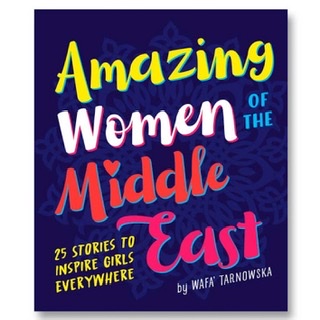
This is a fascinating book. Fascinating, important and inspiring, this collection of ‘amazing women’ fully deserves a place in every school.
This beautifully presented book, fully illustrated throughout, is original in both concept and style. Readers are able to learn about a number of courageous and remarkable women from ancient history to the present day. Each mini-biography is introduced by Wafa’ Tarnowska in an inviting storytelling style that instantly engages the reader. The wide variety of women included, from ancient rulers to astronauts, from writers to ice skaters, come from every possible walk of life and from different countries within the Middle East. Young readers will be able to find one among these who could act as a role model. This brilliant book does much to challenge stereotypes and would be wonderful to share in the classroom either as a book to read aloud, for research or for independent reading for pleasure. There is a helpful map of the countries and a useful glossary is included too. I found this an enjoyable and eye opening read and think this is suitable for a wide readership. An excellent example of how nonfiction is able to broaden minds and educate all ages about our global community.
Amazing Women of the Middle East by Wafa’ Tarnowska illustrations by Christelle Halal, Hoda Hadadi, Sahar Haghgoo, Estelí Meza, Margarida Esteves is published by Pikku Publishing on 20th September.
The online launch takes place at 7pm on 20th September and promises to be an enjoyable event. If you would like an invitation, you can email info@pikkupublishing.com.
Wafa’ Tarnowska has generously taken time to answer my questions on the blog today and I hope you find this interview as inspiring as I did. Wafa’ deserves a place in her own book!
Interview with Wafa’ Tarnowska
AT: Your previous books have been predominantly fiction including retellings of traditional tales for children; what prompted the change to non-fiction and specifically this collection of biographies?
WT: The Me-Too movement. I wanted young people to know that Me-Too is a world movement not specific to the West, that it had started sprouting hundreds of years ago in the Middle East with heroines like Cleopatra, Zenobia, Semiramis, Nefertiti and the Queen of Sheba and that it continues to blossom in our days with women like Amal Clooney ( human rights lawyer), Nadia Murad (Nobel prize winner and activist),Dame Zaha Hadid (extraordinary architect) and Anousheh Ansari (the first Muslim woman to go to space) to name a few.
AT: There is a lyrical, storytelling quality to each of the biographies and I wonder how much of that was a natural inclination as a professional storyteller or if it was a deliberate style choice.
WT:It is definitely a result of my love and practice of storytelling. A story is 27 times more memorable than a fact and the Middle East is famous for its storytelling tradition with the hakawati (storyteller) entertaining young and old in market squares and cafes.
My personal role model is Shahrazade of the Arabian Nights who is included in my book. Anyone who entertained a man (Shahrayar) and a teenager (her sister Duniazade) for 3 years, i.e. for 1001 Nights, and kept them both interested in her stories, is worth emulating. She is a cultured woman with a dazzling imagination and a fantastic sense of humour.
AT: The women are inspiring role models who confound the traditional stereotype of the female from the Middle East. This book will do much to enlighten readers all over the world. What role do you think children’s books play in creating a bridge between cultures?
WT: Building bridges between East and West is my mission in this lifetime. And for bridges to be effective they should start at a young age. That’s why all my books are cultural bridges from the Middle East to Europe, America and the world. From Phoenician myths and legends, to Sufi tales, to the Arabian Nights, to Amazing Women of the Middle East, my books aim at opening the minds of the young to other worlds and other cultures that are part of our planet’s legacy.
The same goes with foods. When children taste hummus and olives and figs and dates, they ask questions, they want to know where theses foods come from. They might want to visit the countries that produced these foods one day.
I think the role of all educators and children’s writers is to broaden the horizons of young people to show them the beauty in diversity and the value of differences. Moving away from fear of the other, because they are different from us, into curiosity about the other, then acceptance, then love, is the journey we are all asked to take, young and old.
AT: Your own life story as a refugee from Lebanon, award winning author and speaker serves as an example of what can be achieved. Would you ever consider writing an autobiography?
WT: I have just signed a contract with Barefoot books for a story I wrote about two children living in a war zone. The story is influenced by my experience of living under the bombs as a teenager for several months in Beirut in 1975, and by an event that happened at the beginning of the Syrian war (in 2012) also involving teenagers.
It took me 45 years to be able to talk about my war experiencesbecause I was traumatised by them. That’s why I don’t watch violence or read violence, and I’ve been a vegetarian since I left Lebanon aged 19. So yes, I am starting to think of an autobiography, very much one of gratitude to the countries that opened their doors to me and my family and allowed me to blossom and become the woman I am now.
AT: Your literary work includes translations into Arabic of children’s books for the publisher Mantra Lingua. September is World Kid Lit Month, a time to celebrate world literature for children and teens, especially fiction and nonfiction translated to English from other languages. How can we as librarians, teachers and parents ensure that children in the UK are made aware of and exposed to the rich variety of stories from other countries and cultures? Do you have any advice?
WT: There should be International Book Day or week where every child is asked to look for a story that is not from the UK and share it with others during story time or geography. Children can dress up in the costumes of the countries these stories come from and bring food to share from these countries. Opening young people’s minds to diversity must be a joyful experience and not become another chore. Chores make people resentful, sharing experiences make people happy.
My “Amazing Women of the Middle East” has a map of the countries where these 25 women come from. It is to help teachers and parents situate the action of the stories. The book also has a glossary of words children might not have heard of. This is also to stimulate discussion in class or at home about a region that is usually known for war and not for inspiring role models.
AT: You are involved with the Stories in Transit project which organises storytelling workshops in the UK and in Palermo, bringing young migrant students together with artists, writers and musicians. How is this initiative helping these students and has it been able to continue during the pandemic?
WT: Like all cultural activities that depended on face to face interaction, because of the Covid19 lockdown, we have had to recalibrate and think of ways to continue our workshops virtually until travel becomes safe. We just had a virtual meeting to discuss new projects.
In the meantime, the migrant students of Palermo had started a group called Giocherenda, a word that comes from pulaar (an African language). It means “solidarity, awareness of interdependence, strength through sharing and the joy of doing things together”.
In December 2019 they opened a shop in which they sell innovativestory telling tools to help teachers and students, workshop leaders and participants, become actors and creators of fantastic worlds andcaptivating stories. If your readers are interested in these storytelling tools please take a look at this link: https://giocherenda.it/en/our-games/
AT: Will you be pursuing the nonfiction approach in the future or do you have other plans? I would love to know what to expect next.
WT: I am researching a nonfiction book for young people and writing my first book for grown-ups. During lockdown, I have recorded 8 of my stories from my“Seven Wise Princesses” and “Arabian Nights” for the Qatar Foundation Read Aloud initiative on video. If you feel like listening to a story this evening please press on this link: https://www.qfi.org/read-alouds/
My plan is to continue expanding my creativity and to be open to new opportunities as a storyteller, broadcaster, translator, and writer, worldwide.
Thank you very much Wafa’ for this enlightening and inspiring interview. I have learned much from you and from your wonderful book which I hope is read widely by children and young people and, in fact, adults too.
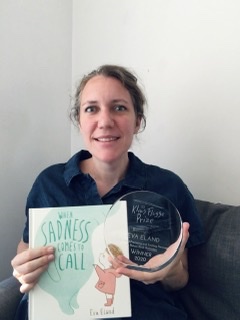
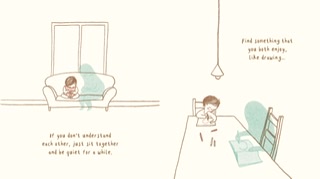
On the evening of 16th September the announcement was made that Eva Eland has won the 2020 Klaus Flugge Prize for the most exciting and promising newcomer to children’s picture book illustration. She won for her book When Sadness Comes to Call (Andersen Press), in which a young child opens the door to an unexpected visitor, Sadness, personified as a semi-transparent amorphous shape. As the two spend time together, the child comes to know and understand Sadness, and then one day wakes up to find the visitor has left. Described by the judges as “a masterpiece of minimalism”, it is a sensitive and profound exploration of a complex emotion in a story that will speak to every child, no matter how young.
Eva Eland grew up in Delft, Netherlands. She studied at the Gerrit Rietveld Academy and the School of Visual Arts in New York as well as at the Cambridge School of Art, where she received a distinction in children’s book illustration. She started working on the book while on the prestigious Cambridge MA course. Judge and winner of the 2019 Klaus Flugge Prize, Jessica Love says: “This book is profound in its simplicity. There isn’t a single line that Eva Eland puts down that doesn’t tell the truth. Perfect.”
On receiving the prize, Eva Eland said: “To be shortlisted for the Klaus Flugge Prize was such a delightful surprise and a huge honour, and now I’ve learned I won the award as well! It’s very encouraging to receive recognition like this and it will also help me to dedicate more resources to developing my work further. And I can’t help but smile at the fact that this often unwanted guest, called sadness, is now finding its way and being welcomed by so many more people and children, with a little help from my book and the Klaus Flugge Prize.”
Now in its fifth year, the Klaus Flugge Prize was founded to honour publisher Klaus Flugge, a supremely influential figure in picture books. Flugge set up Andersen Press in 1976 and has discovered and nurtured many of today’s most distinguished illustrators including David McKee, Tony Ross, Satoshi Kitamura, Ruth Brown and Susan Varley.
Chair of the judges, Julia Eccleshare said: “The Klaus Flugge Prize puts picture book illustration and illustrators into the spotlight and, in its fifth year, we were particularly excited by the standard of books submitted and by the talent and ambition demonstrated by the shortlisted illustrators. When Sadness Comes to Call stands out, however. It is very much a book for today when so many children will be experiencing sadness, struggling to understand why and how to express themselves. Yet it also has the makings of a classic, a perfect meeting of intention and delivery, and an example of how much picture books can do.”
The breadth of subject matter depicted in the shortlisted books indicates how varied picture books are at the moment. The five shortlisted books included an exploration of emotions, a reworking of the traditional counting book, a magical adventure full of family love, a funny dash through a department store and a quality reference book. The judges also chose to award Highly Commended to Sabina Radeva for her book, On the Origin of Species, an illustrated retelling of Darwin’s famous book. Judge, Mini Grey said: “It’s a work of ingenious inspiration that is able to take a complicated idea and make it visually simple, and that’s what On the Origin of Species does. Elegant illustrations help us venture deeper into the concepts and work on many levels: for example, showing the evolution of the eye, and convergent evolution. This beautifully produced book celebrates nature and the voice of Darwin.”
Alongside Mini Grey and Jessica Love, the judges are Meera Ghanshamdas, bookseller at Moon Lane Ink; children’s book consultant Jake Hope; and Pam Smy of Anglia Ruskin University. Julia Eccleshare, director of the Children’s Programme at the Hay Festival, is Chair of the Judges.
You can find out more information about the award and details of previous winners on the official website.
You may enjoy this lovely video created by Eva Eland showing the development of her award winning book.
Hello and welcome to another look at some of the latest news from the world of children’s books. It has been another busy week with awards, comment, resources and ideas linked to children’s literature circulating online.
What I’m reading…
I started the week by taking part in the blog tour to mark the publication of To the Island, a magical, fantastical picture book based on the Irish mythological island Hy Brasil. The Anisha, Accidental Detective series by Serena Patel had been on my book radar for a little while and this week I read and reviewed the second book, School’s Cancelled! It is a delight. Full of warmth and humour with an inspiring protagonist, this is definitely recommended.
Moon over Manifest by Clare Vanderpool, a Newbery Medal winner, was recommended earlier in the year in one of those articles listing ‘books to read during a pandemic’. I eagerly sourced and bought a second hand copy but as gloomy news and uncertainty spread quite honestly I went off the idea. However I started it this week and am enjoying it very much so far, particularly the lead character, Abeline. I’ll keep you posted!
A highlight of the week in the world of children’s books was the announcement of the winner of the Branford Boase Award. Inevitably the ceremony took place online and I don’t think it is merely because I am now more used to this type of event that I found it thoroughly enjoyable. Fascinating discussions, entertaining authors and editors together with knowledgeable book lovers ensured an entertaining hour and a half. You can read more about it here.
News and resources…
Wellbeing and literacy: Resources linked to The Book of Hopes – the Literacy Trust In partnership with Place2Be and Bloomsbury Children’s Books have developed free resources based on the Book of Hopes, a beautiful collection with contributions from many well known authors, illustrators and poets, to support wellbeing and literacy. Each activity is linked to a story, illustration or poem and the resources include downloadable PowerPoints, differentiated material for KS1 and 2 and teacher guidance.
BBC Radio4: A Point of View Thinking Otherwise with Michael Morpurgo – As children return to school, Michael Morpurgo argues that it’s time to rethink our education system and its use of endless data gathering and algorithms. This was broadcast last weekend but is still available to listen to.
Life in the Information Jungle – Susan Martineau – in this article on the CILIP website, Susan discusses the importance of critical literacy, navigating fake news and some of the background to the writing of Question Everything (reviewed below by Veronica Price). Both the article and the book highlight the need for school librarians to guide pupils through the maze of information available, sadly not all of it trustworthy.
The My Twist on a Tale: Everyday Heroes competition is officially open – run by Pearson, this free competition, is now open to four- to 19-year-olds across the UK. Encourage young people to let their imaginations run wild as they write a story based on the new theme for 2020: Everyday Heroes. Information and entry packs are available on the website.
North Somerset Teachers’ Book Awards – the shortlists for these annual awards have been announced, slightly longer than usual and with a variety of categories, these are a good way of keeping in touch with quality children’s books. Any teacher, teaching assistant or school librarian is able to vote for the awards so perhaps explore the website to find out more.
A look at the Klaus Flugge Prize Shortlist – the winner of this prestigious award is announced on 16th September and this article in Books for Keeps is a lovely reminder of the shortlisted picturebooks. There are teaching resources for each of the shortlisted books created by CLPE available here.
Rebel Rebel: how books and libraries can challenge mainstream narratives – this free webinar on 30th September run by the Chartered Institute of Library and Information Professionals featuring Jake Hope, Michael Rosen, Smriti Halls and Fen Coles is is aimed at public and school librarians and anyone with an interest in children’s and radical publishing.
Bearmouth Wins the Branford Boase Award – Liz Hyder and her editor Sarah Odedina of Pushkin Children’s Books win the 2020 BRANFORD BOASE AWARD awarded to the author and editor of the outstanding debut novel for children.
On Black and Asian Authors Who Deserve to be Much Better Known – thank you to Imogen Russell Williams for this excellent article in the Times Literary Supplement. This overview would be a great starting point but as Imogen said on Twitter there are many more authors available but space only allowed for those mentioned.
Blue Peter Book Awards School Judges – Since 2000, the enormously popular and influential Blue Peter Book Awards have been recognising and celebrating the best authors, the most creative illustrators and the greatest reads for children. Application for School Judges for 2021 is now open. Deadline Friday 9th October, 5pm.
Reading for Pleasure: The Nectar of Imagination (free webinar) – Join The Reading Agency and the Open University for this exciting webinar. Sharing research and practical advice, the expert team including Teresa Cremin (researcher), Matt Courtney (teacher), and Sonia Thomson(headteacher) will also answer questions and offer news of the Teachers’ Reading Challenge.
‘H is for Harry’ online screening in aid of Coram Beanstalk Tursday 17th September. – a fundraising campaign called “Closing the Covid Gap” set up by Rosemarie Ghazaros has secured an exclusive online screening of ‘H is for Harry’ in aid of Coram Beanstalk, Action Tutoring and Think Forward. This thought provoking film follows 11 year old Harry as his teacher tries to help him overcome his illiteracy and years of feeling excluded from learning and opportunity. After the film, you may join Roz Pedder, a secondary school teacher, and a Zoom panel with co-director Edward Owles, Angela Fuggle, Head of Programmes at Coram Beanstalk and a representatives from the charity Think Forward. Tickets are £6. I have seen this film, it is most definitely worth watching. Tickets are available via the link above.
Finally, some book reviews that caught my eye this week…
Taking Time by Jo Loring-Fisher – this picture book published by Lantana Publishing sounds beautiful. A journey around the world witnessing special moments through a child’s eyes and savouring them will surely encourage mindfulness. A gorgeous review by Jill Bennett.
The Magician and his hat: A review of The Finn Family Moomintroll by Tove Jansson – as part of #WorldKidLit month Chris Lovegrove has shared his thoughts on this popular children’s classic. I always enjoy Chris’s excellent reviews and learn something new from them each time I read them and this one is no exception. It has also resulted in me rescuing my copy from the shelves for a reread!
The Thing at Black Hole Lake by Dashe Roberts – I enjoyed the BigWoof Conspiracy very much, an entertaining and amusing story and this sequel sounds to be just as good. In his review Chris Soul says “Sticky Pines is fast becoming that must-read series” so this is definitely book to look out for.
Zombierella by Joseph Coelho and Freya Hartas – one of the Just Imagine Summer School sessions this year looked at the influence of fairy tales and examined the reimagining of them in children’s literature. This great review by Mat Tobin has reminded me of that discussion. I think it is impossible to resist a book “that drips with cunningly dark imagery and design whilst managing, somehow, to include a lightness of touch and humour that will leave readers grinning.”
Well, I think that is it for this week. It’s been another busy one with yet more fabulous new books appearing for us to read, share and talk about. I hope that something in this compilation has piqued your interest. Happy reading!







 Library Lady